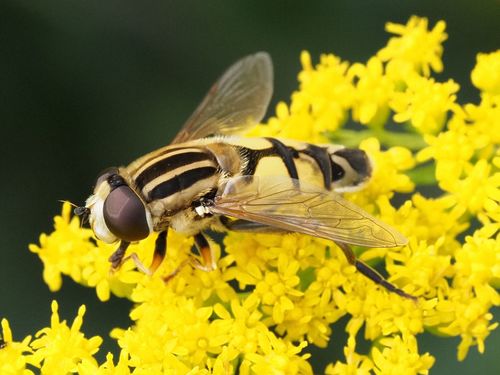
About Helophilus trivittatus (Fabricius, 1805)
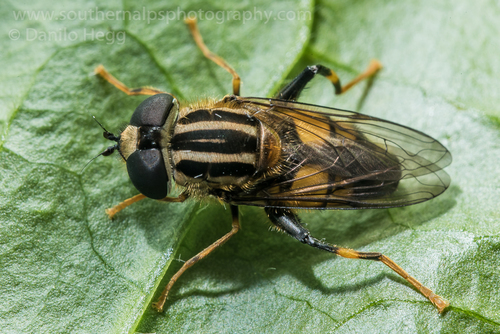
For morphological terminology related to this species, refer to Morphology of Diptera. Helophilus trivittatus has a wing length ranging from 10.25 to 12.25 millimetres (0.404 to 0.482 inches). The eyes are separated in both sexes, with a slightly smaller separation in males than in females. The antennae are black. The face has a wide yellow longitudinal stripe, with at most a narrow central reddish-brown stripe. On the thorax, four narrow pale yellow stripes alternate with three larger dark brown stripes. The patterning on the flattened abdomen resembles that of a wasp. The patterning on the third and fourth abdominal segments differs between the two sexes. In males, only the third segment bears a pale yellow to gray arc-shaped marking. In females, this same curved marking is present on the fourth and fifth tergites. Tergites 2 and 3 have pale lemon yellow spots, while tergite 4 has white to grey spots. In females, the yellow spots on tergite 3 reach the front margin of the segment. The larva of this species was illustrated by Hartley (1961); see references for species determination resources. This species is present across most of Europe and the eastern Palearctic realm. It has a widespread distribution, ranging from Fennoscandia south to the Mediterranean Basin, and from Ireland east through Europe, Siberia, and the Russian Far East to the Pacific coast. It is also found in Iran and Afghanistan. Migratory individuals of this species have been observed in Sweden. These hoverflies live in wetlands, river margins, seasonally flooded grassland, and salt-marsh. In southern Europe, they are commonly found near human agricultural areas, where they frequent irrigation ditches in farmland.