About Helophilus obscurus Loew, 1863
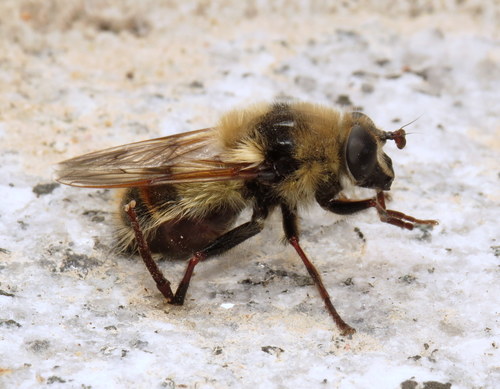
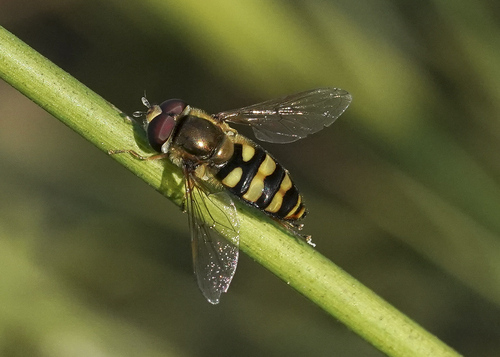
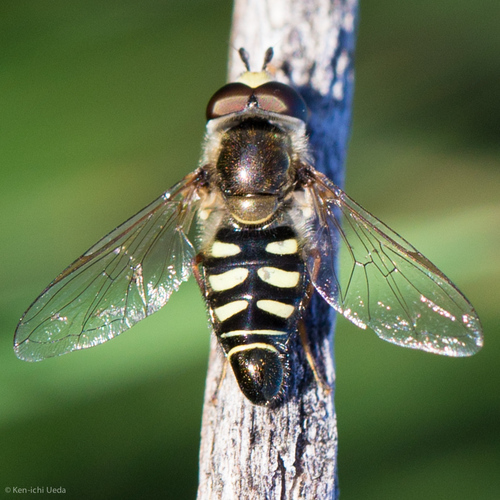
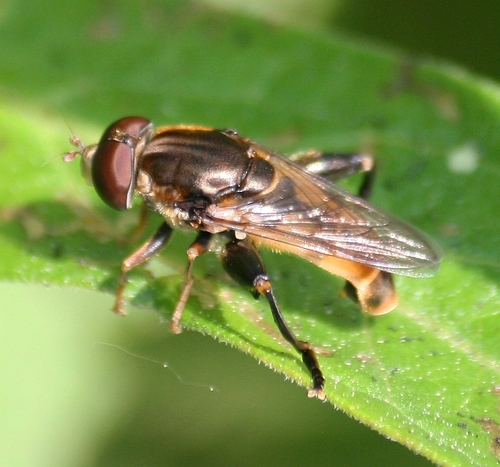
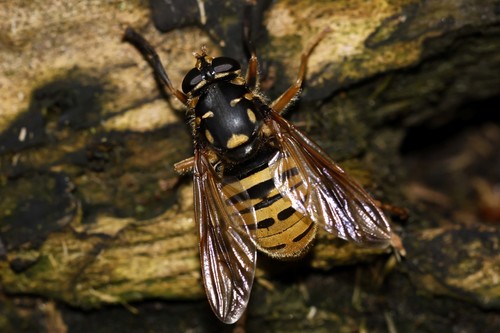
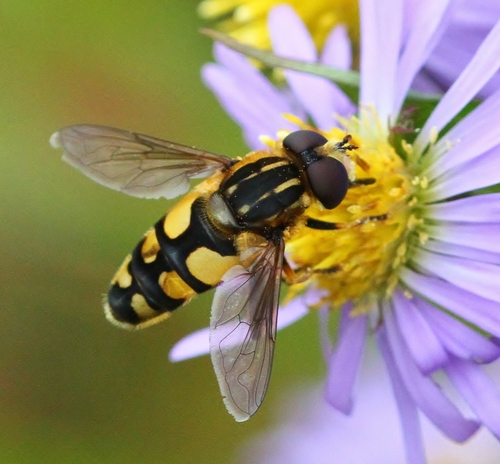
This species is scientifically named Helophilus obscurus Loew, 1863. Terminology follows the Speight key to genera and associated glossary. Adults measure 10–13.5 mm (0.39–0.53 in) in length. The face is orange-yellow, marked by a median black stripe that extends almost to the antennae. The oral margin and cheeks are shining black. The yellow regions of the face and frons are densely covered in yellow pollen; the pollen on the face is typically pale. In profile, the upper two-thirds of the face is moderately excavated, while the lower portion is slightly retreating. The frons is narrow at the top; more than half of this narrow upper section is covered in black pile, except for the venter, with yellow pile covering other areas. The female frons narrows somewhat toward the top, with black pile only on its upper half, and rarely extends this black pile almost to the antennae. The antennae are black; the third segment (flagellum) is mostly or nearly entirely red, with brown upper and apical margins. The arista is orange-yellow. Males have separated eyes. The occiput is yellow pollinose on roughly its upper half, while the lower half is covered in greyish yellow pollen and white hair. The scutum is black, with yellow to pale yellow side margins and a pair of broadly separated yellow to pale yellow vittae. The vittae typically narrow behind the transverse suture, and are sometimes interrupted at this point. There are also two wider spots located just before the scutellum. The scutellum is translucent brownish, with a reddish apex. The thorax has yellow pile, while the scutellum bears short, abundant black pile except along its margins. The pleura are greyish yellow pollinose. The male abdomen has three pairs of more or less oval spots; the first pair is large and somewhat triangular, while the last pair is slightly lunulate. The female abdomen has four pairs of yellow spots, which are more transverse in shape than the spots found on males. On the third abdominal segment of females, these spots only reach the sides toward the front, and the pollinose bands on the fourth segment are more oval, scarcely concave at the front, and not lunulate. At the basal corners of the fifth segment, females have transverse pollinose triangles that are narrowly separated in the center. The male abdomen is opaque black; the narrow apex of the second segment, the apex of the third segment, and the broad apex of the fourth segment are shining. The second abdominal segment of males is yellow, except for black marking on its broad apex, broad median stripe, and base. The black marking at the base is rather rounded laterally and broadly separated from the side margins. The base of the third segment has a rather broad, sub-oval spot on either side, and the fourth segment has a broad, slightly lunulate yellow pollinose spot on either side near the base. The apices of the segments are successively more widely reddish. The abdominal pile is black, with yellow pile in front of the hind margin of the yellow markings on each segment and on the sides of the fourth segment. The genitalia are usually black, with only one recorded specimen having reddish genitalia. The wings are either hyaline or tinged with yellow. The stigma is brownish. The squamae are pale yellow, with a yellow fringe. The halteres are pale yellow. The legs are mostly black, with some yellow or reddish-yellow areas. Yellow or reddish-yellow markings include the apices of the four front femora, the first two joints of the middle tarsi, the basal third to half of the front tibiae, and all of the middle tibiae. Yellow or reddish markings can also be present on the hind femora, as a narrow sub-apical band and at their bases, along with the basal third of the hind tibiae, and sometimes a narrow median band.