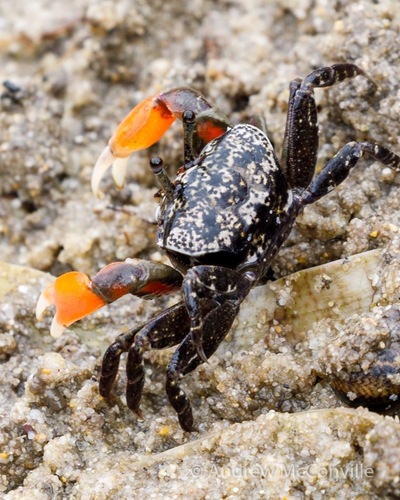
About Heloecius cordiformis (H.Milne Edwards, 1837)
Adults of Heloecius cordiformis are around 25 mm (1 in) wide, with a dark purple, mottled carapace. Their compound eyes sit on long eyestalks. The species exhibits sexual dimorphism in claw size: male claws show positive allometry (growing proportionally larger as the crab grows), while female claws grow isometrically. As a result, fully grown males have much larger claws than females. Claw color correlates with both sex and body size: the smallest crabs have green claws, followed by orange and pink, and the largest male crabs have purple claws. Females that have purple claws always have small claws. Out of the four claw colors, purple is the easiest to distinguish against the reflectance spectrum of the mudflats where this crab lives. Heloecius cordiformis is distributed along the Australian east coast, ranging from Brisbane in Queensland, along the coast of New South Wales to Port Philip Bay in Victoria, and also occurs in eastern parts of Tasmania. This species lives in intertidal mangrove habitats and estuaries, where it is the most abundant crab species, and typically occurs among mangrove roots. Heloecius cordiformis can breathe both in air and in water. When out of water, it moves its carapace up and down; this movement lets it breathe air while retaining water held in the gill chamber under the carapace. It is primarily a deposit feeder, sifting through sediment to collect organic matter and mangrove detritus, but it also has large mandibles that allow it to consume larger pieces of plants and animals. Both males and females use their claws alternately when feeding: while one claw transfers food to the mouthparts, the other collects more material. Predators of Heloecius cordiformis include a wide range of birds and fish. Males signal to other crabs by waving their brightly colored claws, which gives the species its common name of "semaphore crab".

