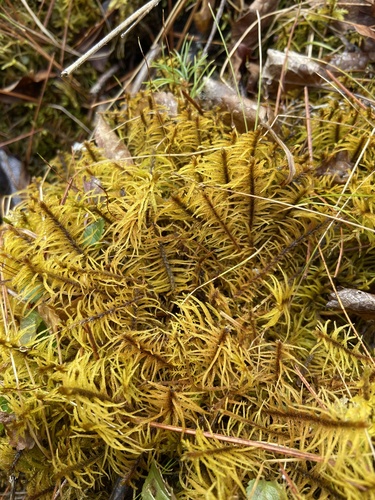
About Helodium blandowii (F.Weber & D.Mohr) Warnst.
Helodium blandowii (F.Weber & D.Mohr) Warnst. is a moss that forms yellow-green loose tufts. Despite being pleurocarpous, it grows ascending, with regular, close pinnate branching; all branches lie in a single plane, creating a feather-like shape. Stems measure 4–11 cm long, are more or less erect, and are quite stiff when dry. They are densely covered in unbranched, lobed green filamentous paraphyllia that turn brown toward the lower stem. Branches are unequal in size, simple, widely spaced along the stem, and about 1 cm long. Stem leaves are large, more or less triangular-ovate, ending in a short, slender point. They are somewhat plicate and concave, appressed to the stem except at their tips, with paraphyllia growing from their decurrent leaf bases. Leaf margins are either flat or often rolled backward, and can be entire, or have irregular fine teeth or larger teeth along the middle and lower parts of the leaf. The costa extends beyond the middle of the leaf, and the leaf size is 1.3–1.8 mm long by 0.7–1 mm wide. Branch leaves are small, about 0.8 mm long, become contorted when dry, and range from broadly ovate-acuminate to ovate-lanceolate. This species is autoicous, with both male perigonia and female perichaetia borne on the stems. The seta is 3–5 cm long, slender, and reddish brown. Capsules are rare; when they develop, they are smooth and oblong-cylindric, becoming strongly curved and nodding. The short capsule neck is somewhat wrinkled, and the urn is 2.5–3.5 mm long, yellowish-brown that turns reddish brown as it ages. The operculum is conical, pointed, and grows up to 0.8 mm long. The annulus is made of 3 rows of deciduous cells, and the cilia are 2–3 in number, long, and more or less appendiculate. Spores are smooth and reach maturity in August. The calyptra is cucullate, or hood-shaped. For field identification, this species is superficially similar to other related mosses, but growing in a fen habitat greatly aids identification. Its distinctive features include feather-like, flattened stems and branches, its yellow-green colour, and the dense covering of paraphyllia on its stems. Its pale yellow-green colour may initially be mistaken for Sphagnum, but H. blandowii can be distinguished by its pinnate growth habit, in contrast to the fasciculate growth habit of Sphagnum. Helodium blandowii, commonly called Blandow's bogmoss, has a circumboreal distribution. It grows in montane minerotrophic, or moderately rich, fens or mires, typically with calcareous groundwater, where it forms mats and small hummocks. It sometimes grows under grasses, sedges and shrubs at the edges of these wetland features, or within them in small rivulets. Vascular plant species commonly associated with H. blandowii include Agrostis idahoensis, Betula glandulosa, Salix geyeriana, Carex limosa, Eleocharis pauciflora, and Scheuchzeria palustris. Associated moss species include Aulacomnium palustre, Calligeron stramineum, Hamatocaulis vernicosus, Meesia triquetra, Tomenthypnum nitens, Philonotis fontana, Drepanocladus vernicosus, and Hypnum lindbergii. Fens that host Scorpidium species or Drepanocladus revolvens are too ion-rich to be suitable habitat for H. blandowii. This species was declared extinct across the British Isles in 1901, and has not been recorded there since. Little is known about the fire ecology of this moss, though fens rarely burn. However, excess soot from nearby fires may negatively impact the quality of its habitat.

