About Heloderma horridum (Wiegmann, 1829)
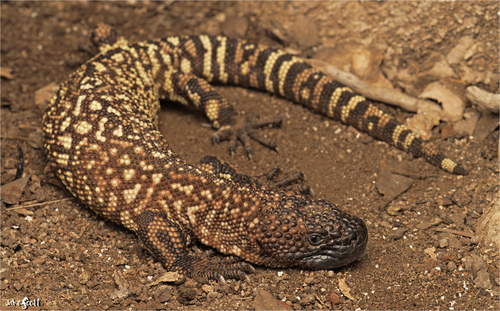
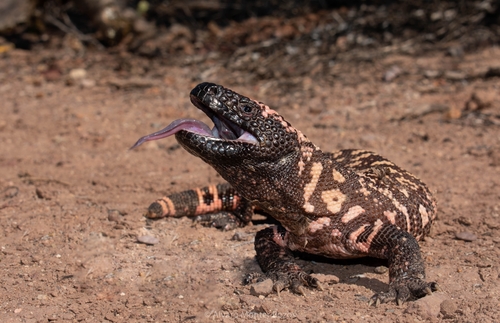
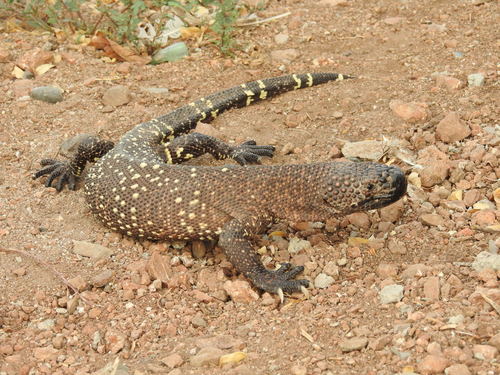
Adult beaded lizards (Heloderma horridum) range in total length from 57 to 91 cm (22 to 36 in), which is substantially larger than Gila monsters that only reach 30 to 56 cm (12 to 22 in) in length. The average snout-to-vent length of a beaded lizard is 33 to 48 cm (13 to 19 in). The average body mass of an adult beaded lizard is 800 g (1.8 lb), about 45% heavier than the average mass of a Gila monster. Large specimens can exceed 2,000 g (4.4 lb), and the maximum known weight for the species is 4,000 g (8.8 lb). Although males are slightly larger than females, this species is not considered sexually dimorphic. Both sexes have stocky bodies and broad heads, though males tend to have broader heads than females. The scales of beaded lizards are small, beadlike, and do not overlap. Most of their scales are underlaid with bony osteoderms, with the exception of scales on the underside. Their base color is black, marked with variable amounts of yellow spots or bands. Beaded lizards have short tails that they use to store fat to survive months of estivation. Unlike the tails of many other lizards, a beaded lizard’s tail cannot regenerate if broken. They have forked, pink tongues that they use to sense smell with the help of a Jacobson's organ: they extend their tongues out to gather scents, then touch the retracted tongue to the opening of the organ. Beaded lizards are found in Pacific drainages from southern Sonora to southwestern Guatemala, and in two Atlantic drainages from central Chiapas to southeastern Guatemala. Their primary habitats include deserts, tropical deciduous forests, and thorn scrub forests, but they also occur in pine-oak forests, at elevations ranging from sea level to 1500 m. In the wild, these lizards are only active from April to mid-November, and spend approximately one hour per day above ground. The Mexican beaded lizard H. horridum is found in Mexico, from Sonora to Oaxaca. The Rio Fuerte beaded lizard (H. exasperatum) occurs from southern Sonora to northern Sinaloa. The Chiapan beaded lizard (H. alvarezi) is found in northern Chiapas and the Río Lagartero depression in Huehuetenango to northwestern Guatemala. The ranges of these three species overlap, meaning they are sympatric. The Guatemalan beaded lizard (H. charlesbogerti) is the only allopatric population, separated from the nearest population (H. alvarezi) by 250 km of unsuitable habitat. It is the most endangered beaded lizard, and potentially the most endangered of all lizards; it is only found in the dry valley of the Río Motagua in northeastern Guatemala, and fewer than 200 individuals are believed to exist in the wild. Beaded lizards reach sexual maturity as early as 3 years of age, and typically mate during the summer months. In captivity, breeding generally follows this seasonal pattern, but successful breeding can occur in any month of the year. Males participate in ritual combat that can last for several hours, and the winning male mates with the female. Clutches of 2 to 30 eggs are generally laid in late summer or early fall, and hatch the following spring or summer. Young beaded lizards are seldom seen. It is believed that they spend most of their early lives underground, and only emerge once they are 2–3 years old and have gained considerable size.