About Helminthostachys zeylanica (L.) Hook.
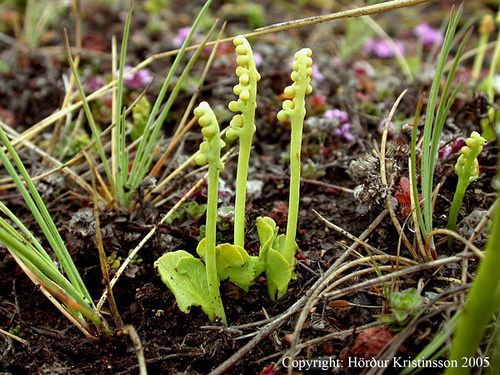
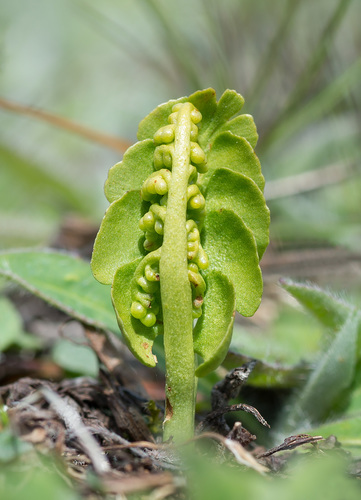
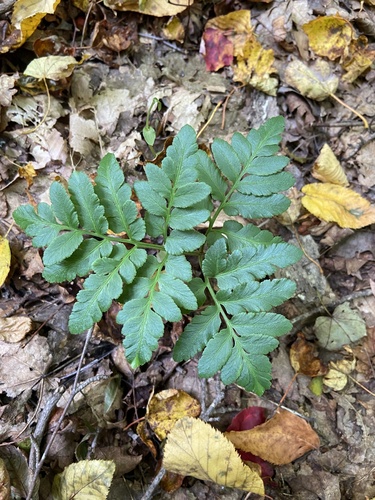
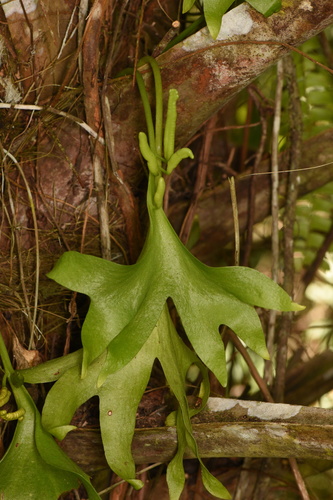
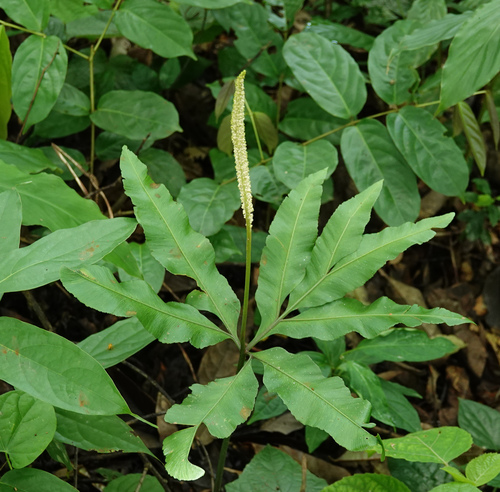
Helminthostachys zeylanica (L.) Hook., commonly known as kamraj and tunjuk-langit, is a terrestrial herbaceous fern native to southeastern Asia and Australia. Like other species in its family, it produces clusters of sporangia on the stems of fertile, spike-like fronds. This annual plant has a short, stout, creeping rhizome that grows underground. Individuals can produce either a single frond or multiple fronds. Its leaves are lanceolate, with either entire or irregularly serrate margins. The spikelike fertile frond grows from the base of the leaves on its own stipe. A sterile leafy segment called the trophophore sits below the spike; both the trophophore and the spore-bearing sporophore grow from a common petiole.
The roots of this plant are widely used as medicine in China, where they are called "Di wu gong". Roots are harvested from wild plants only, during the wet season between July and August. In Malaysia, dried leaves of this plant are smoked to treat nosebleeds. In India, the plant is eaten as a vegetable and used medicinally to treat impotence. It is called túkod-langit in the Philippines.