About Helleria brevicornis Ebner, 1868
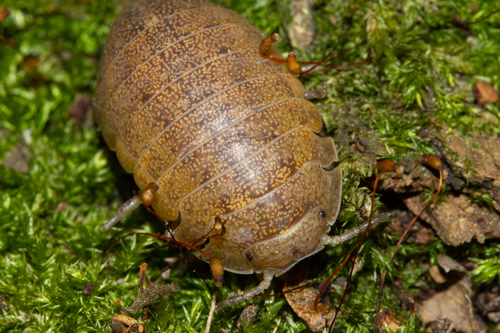
Helleria brevicornis Ebner, 1868 is yellow-brown in color and grows up to 27 millimetres (1.1 in) in length. This species has vestigial antennules, short antennae, and a trapezoid telson. Each of its compound eyes is made up of 19 ommatidia. Juveniles have bumps and setae, while adults are almost smooth with light spots. In adults, the plates of the posterior pleonites fuse with each other after moulting. Like all other members of the family Tylidae, it can roll up into a perfect ball with its antennae tucked inside. This species is found primarily in the oak forests of Corsica, from coastal areas up to 1,200 metres (3,900 ft) above sea level, and also on Sardinia. It also occurs in isolated locations on islands of the Tuscan Archipelago (Elba, Pianosa, and Capraia), the Lérins Islands, the Italian coast (Monte Massoncello), and the French coast (Massif de l'Estérel and Grasse region), up to an altitude of 600 metres (2,000 ft) above sea level. Records of this species at Genoa and Ospedaletti are uncorroborated. A molecular phylogenetic analysis found that the colonization of the French and Italian mainland and the Tuscan Archipelago happened most recently, but could not conclusively determine whether this distribution was caused by climate change during the Late Pleistocene period, or through accidental human transportation of the species. As a detritivore, H. brevicornis lives among and feeds on the leaf litter and humus layers of forest soils, and digs burrows 10 centimetres (3.9 in) deep. It lives in large subsocial groups and engages in conspecific coprophagy. Like other peracarids, female H. brevicornis provide developing embryos with water, oxygen, and nutrients through a specialized structure called the marsupium. Unlike many other terrestrial isopods, female H. brevicornis do not have a seminal receptacle. This means they cannot store sperm, and must mate with a male every time they want to produce a new brood of young. In comparison, most other female terrestrial isopods do have a seminal receptacle, so they can produce multiple broods after mating only once. The hindgut of H. brevicornis is host to the mesomycetozoean parasite Eccrinoides helleriae.

