About Hellenolacerta graeca (Bedriaga, 1886)
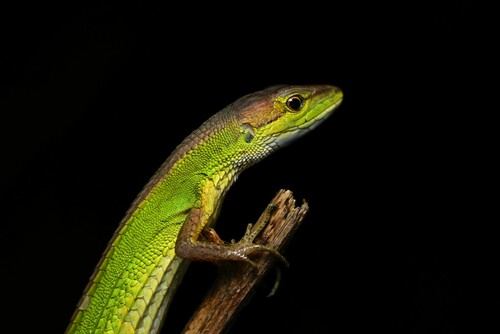
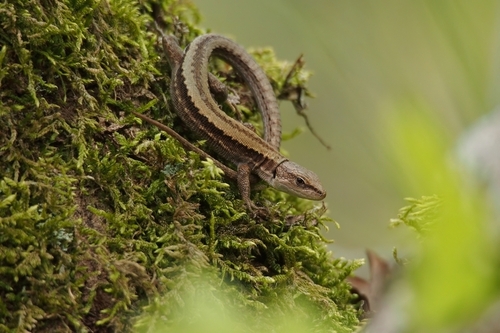
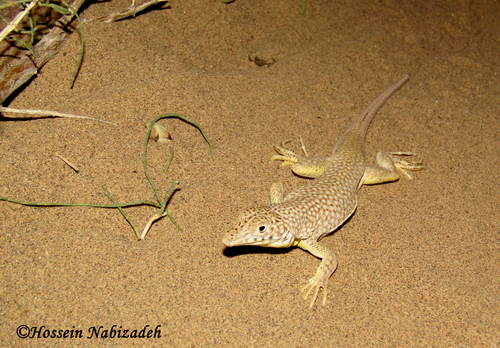
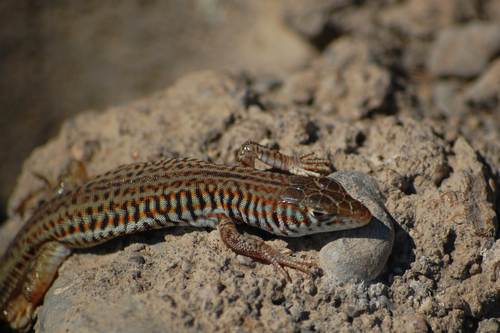
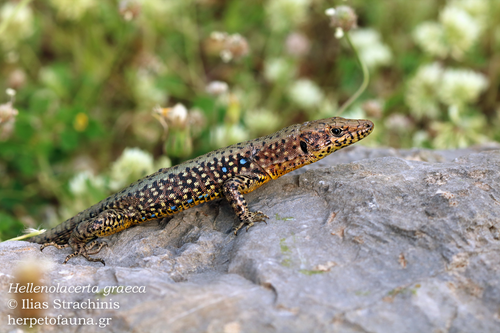
Hellenolacerta graeca, commonly known as the Greek rock lizard, is a medium-sized lizard species. It reaches a snout-to-vent length of approximately 8 centimeters (3 inches), with a tail that is at least twice as long as its body. Its body is somewhat flattened, and its legs are relatively long and slender. The dorsal surface is typically a glossy greyish-brown, though it can also be yellowish-brown, sometimes with a faint reddish tinge. Males have irregular dark spots on the back and dark flanks covered with many small pale spots. Females have smaller heads, fewer dark spots on the back, and their flank pale spots are more diffuse. One or two blue spots are sometimes present above the shoulder; in males, these spots may extend a short distance along the flanks. The underparts are yellow or orange, and are usually speckled with fine dark markings, which are most prominent on the throat. This species is endemic to the Peloponnese region of southern Greece. It occurs at altitudes up to 1,600 meters (5,200 feet) above sea level, though most individuals are found between 300 and 700 meters (980 to 2,300 feet). It typically inhabits humid rocky habitats near streams and pools, light woodland, field edges adjacent to woodland, and shady rocky or scree areas.