About Helleborus viridis L.
Helleborus viridis, commonly known as green hellebore, is a flowering plant species in the buttercup family Ranunculaceae. It is native to Central and Western Europe, including southern England. All parts of this plant are poisonous; consuming any part can cause severe vomiting and seizures. It was among the many species first described by Carl Linnaeus in the 1753 tenth edition of his work Species Plantarum, volume one. The Latin species epithet viridis translates to "green". Recorded common names for this species also include bastard hellebore, bear's foot, and boar's foot.
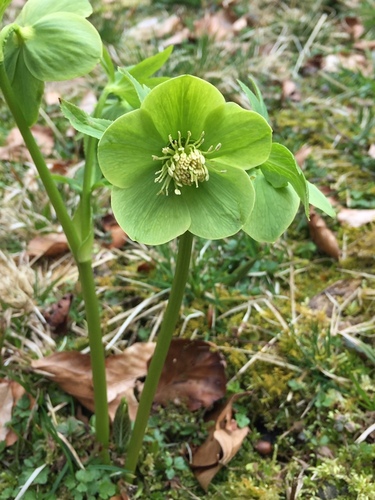
Green hellebore is a semi-evergreen perennial herb that grows to roughly 60 cm (24 in) tall. It has rhizomatous roots. Its flowers bloom in spring, from February to April. Each flower has five large, green, oval sepals with pointed tips, plus seven to twelve much smaller petals. Two subspecies are currently recognized: Helleborus viridis subsp. viridis, native to Central Europe and the maritime Alps; and Helleborus viridis subsp. occidentalis, native to western Europe including the British Isles. Subspecies viridis produces flowers 4–5 cm (1.6–2.0 in) in diameter and has leaves covered in fine hairs, while subspecies occidentalis has smaller flowers 3–4 cm in diameter and smooth leaves.
In its native range, green hellebore occurs across Western and Central Europe, extending east to eastern Austria and south to northern Italy. In southern England, it grows on limestone and chalk-based soils. It has become an invasive species in North America, Scandinavia, the Netherlands, and northern Germany.