About Helix pomatia Linnaeus, 1758
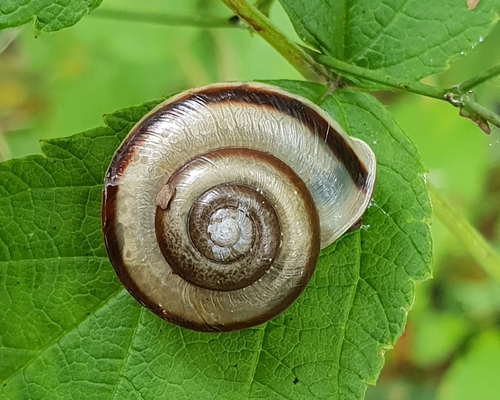
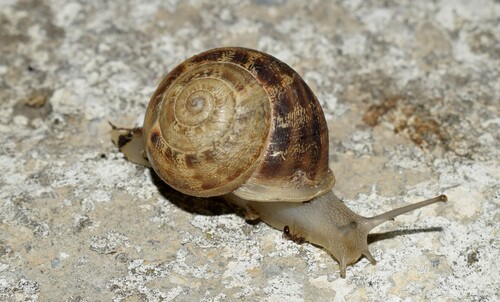
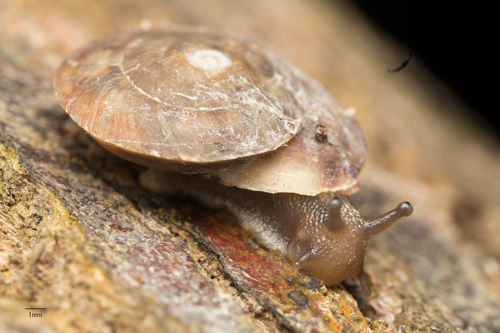
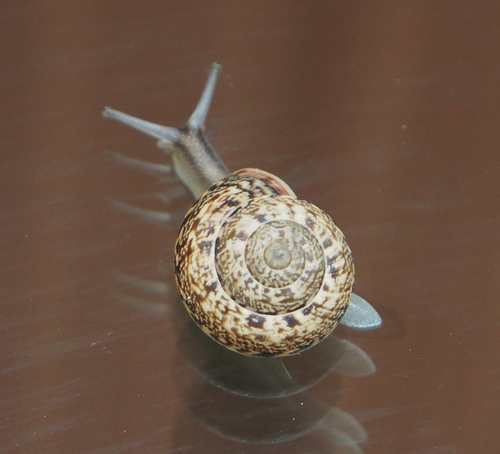
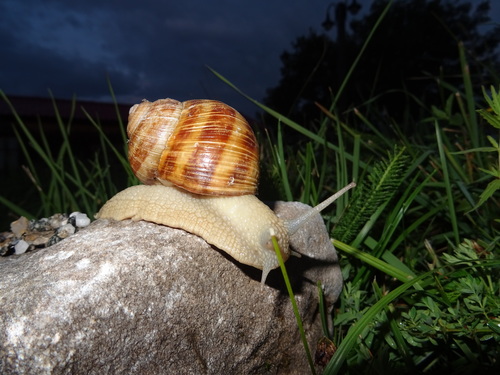
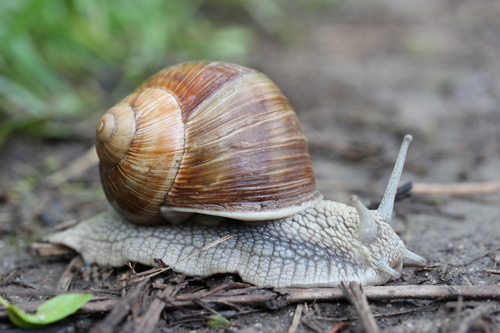
Helix pomatia Linnaeus, 1758 has a shell that ranges in color from creamy white to light brownish. Most individuals have indistinct brown color bands, though some have well-developed, conspicuous banding. The shell holds five to six whorls, has a large aperture, and a slightly reflected apertural margin in adult individuals. The umbilicus is narrow, and is partially covered by the reflected columellar margin. The shell measures 30–50 mm (1.2–2.0 inches) in width, and 30–45 mm (1.2–1.8 inches) in height. The current distribution of Helix pomatia is strongly shaped by human-mediated dispersal and synanthropic (human-associated) populations. The species’ natural native range has its northern limit running through central Germany and southern Poland; its eastern natural limit runs through far western Ukraine, Moldova, Romania, and Bulgaria. In the south, the native range reaches northern Bulgaria, central Serbia, Bosnia and Herzegovina, and Croatia. In Italy, it occurs as far south as the Po River and the Ligurian Apennines, and the native western range extends to eastern France. Currently, H. pomatia is found as far east as western Russia, where it is broadly distributed in and around Moscow, and also occurs in southern Finland, Sweden, Norway, Denmark, and the Benelux countries. Scattered introduced populations occur west as far as northern Spain. In Great Britain, H. pomatia lives on chalk soils in southern and western England. In the east, isolated populations are found as far as the region south of Novosibirsk. Introduced populations also exist in eastern United States and Canada. In Central Europe, H. pomatia occurs in forests, shrubland, and a variety of synanthropic (human-associated) habitats. In the Alps, it can be found at elevations up to 2,100 m (6,900 ft) above sea level, though it most commonly occurs below 2,000 m (6,600 ft). In southern England, the species is restricted to undisturbed grassy or bushy wastelands, and usually does not grow in gardens. The intestinal juice of H. pomatia contains large amounts of aryl, steroid, and glucosinolate sulfatase enzymes. These sulfatases have broad specificity, so they are commonly used as a hydrolyzing agent in analytical procedures such as chromatography, to prepare samples for analysis. The species, also called the Roman snail, has a history of culinary use: Ancient Romans ate these snails, and today they are especially popular in French cuisine. In English cooking, the species is referred to by the French name escargot, which simply means snail. Although H. pomatia is highly prized as a food, it is difficult to cultivate and is rarely commercially farmed.