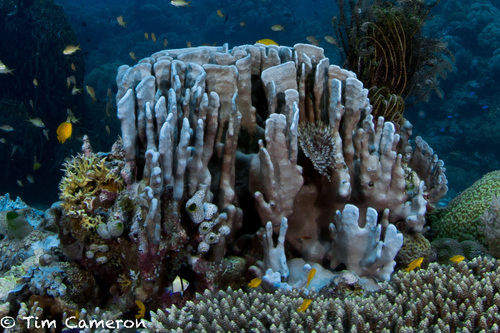
About Heliopora coerulea (Pallas, 1766)
Heliopora coerulea, commonly called blue coral, is the only currently living octocoral that forms a massive skeleton. This skeleton is made of fibrocrystalline aragonite, a form of calcium carbonate. It is a reef-building (hermatypic) species that hosts zooxanthellae, and its polyps, which sit within the skeleton, are either blue or green-grey. Each polyp has eight tentacles. Blue coral colonies can grow in columnar, plate-like, or branched forms. This species is tolerant to varied conditions, so it is used in marine aquariums. Iron salts give Heliopora coerulea's skeleton its unique blue color, which makes it easy to identify in fossil outcrops. As a result, it is quite abundant in paleontological records, and fossils show this species has not changed in form since the Cretaceous period. Blue coral shows specific resistance to environmental temperature changes, and actually grows more in warmer water temperatures. Even though blue coral is common in some areas and has a wide geographic range, the International Union for Conservation of Nature (IUCN) has assigned it the conservation status of Vulnerable. Its total population size is unknown, but populations are thought to be declining alongside global coral reef destruction. It is threatened by collection for aquariums, coral bleaching, habitat destruction, ocean acidification, and climate change. Blue coral is found in the eastern and western Indian Ocean, as well as the eastern central, western central, northwestern, and southwestern Pacific Ocean. Its range includes Australia's Great Barrier Reef, Japan, and the Ryukyu Islands. The largest known blue coral colony is thought to live off Ishigaki Island in the Yaeyama Islands of southwestern Japan. It inhabits reefs at depths below 2 meters (6.6 ft), wave-exposed reefs, reef flats, intertidal regions, and sometimes marginal habitats. Blue coral is listed under Appendix II of CITES (the Convention on International Trade in Endangered Species of Wild Fauna and Flora). The world's largest single deposit of blue coral is located in Shiraho, Japan. In 1989, this deposit was threatened by a proposed airport development that would have built directly over the coral bed, destroying the rare corals. Transnational organization World Wide Fund for Nature intervened, and with public support, successfully blocked construction of the airport at that site. The organization also built a field research station at Shiraho to conduct further studies of these corals. The airport was eventually constructed at an alternate location that did not harm the coral deposit. After this success, the World Wide Fund for Nature attempted to follow its standard procedures and create a formal protected area for the Shiraho blue coral. However, the public support the group had previously received faded, as Shiraho local residents opposed creating the protected area. Conservationists adjusted their approach, and instead worked to connect the Shiraho community more deeply to the sea beyond commercial fishing, to foster local interest in conserving the area. This effort led to the revitalization of sanizu, a local traditional celebration where people give offerings to sea gods. The tradition had become less common over the years due to factors including economic pressure and other local socioeconomic changes. The World Wide Fund for Nature did not lead the celebration directly; instead, it provided the tools and resources needed to hold the event. This resulted in a large-scale sanizu celebration that brought together local residents and conservationists to connect with the sea.

