About Heliophanus cupreus (Walckenaer, 1802)
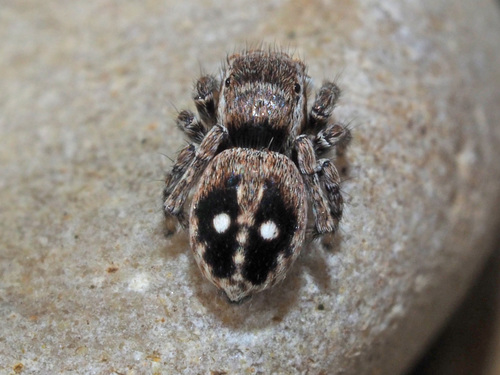
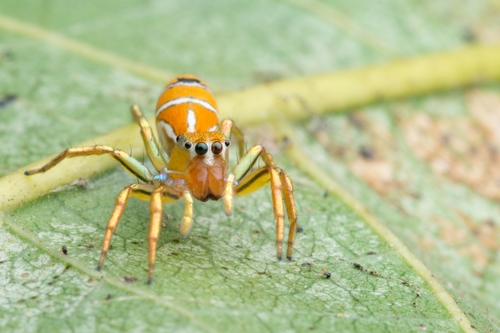
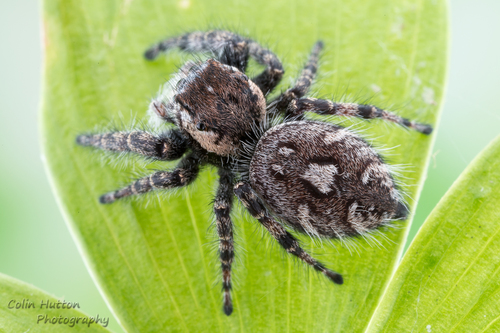
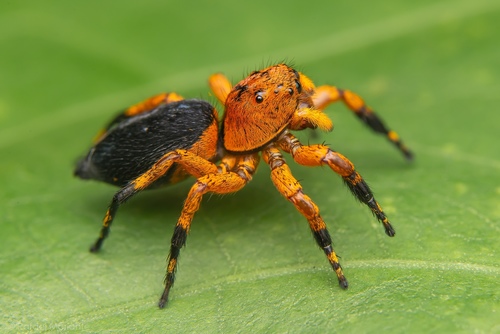
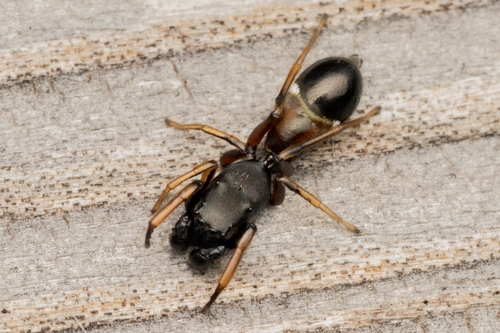
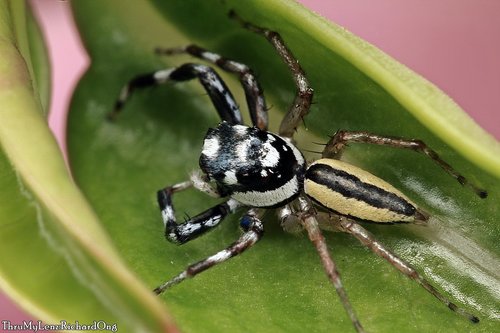
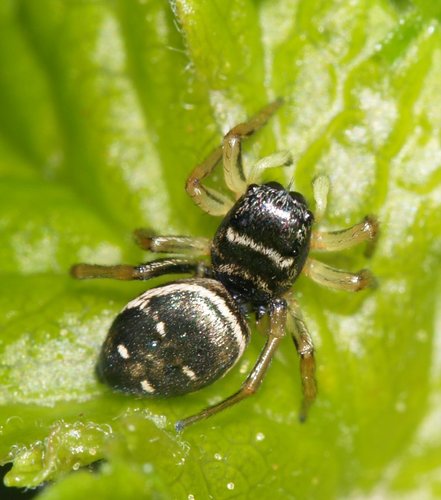
Heliophanus cupreus, first described by Walckenaer in 1802, differs in body size between sexes: males reach a body length of approximately 3.6–4 mm (0.14–0.16 in), while females reach 4.6–5.8 mm (0.18–0.23 in). These spiders have a dark, blackish body with a noticeable metallic sheen. Female pedipalps are yellow or light brown, which creates a clear contrast with the spider's overall dark body. Females usually have a white line crossing the prosoma behind the eyes, a white line circling the abdomen, and white dots on the upper surface of the abdomen. Males have dark pedipalps that bear white scaly hairs on their front surface. The male tibial apophysis has a fine, long, pointed, hook-shaped process, and the male palpal bulb is long. The male cephalothorax is black with a metallic sheen and white hairs; hairs are brighter towards the front, and some males have 1 to 2 bright pairs of spots towards the rear. Most individuals have light yellow legs with black longitudinal stripes, though some individuals have uniformly dark legs. The opisthosoma is grey-black with a metallic sheen and white hairs, matching the body's overall coloration and texture. Heliophanus cupreus has a Palearctic distribution. It is found across almost all of Europe, with the exception of Iceland. It is also present in North Africa, Turkey, the Caucasus, Russia (from European Russia to West Siberia), Iran, and China. In Great Britain, it has a scattered distribution that extends north to central Scotland, where it is typically a coastal species. This spider species can be found in a wide range of habitat types, including woodlands, grasslands, raised bogs, coastal cliffs, shingle beaches, and disturbed habitats like wastelands and quarries. Across all of these varied habitats, Heliophanus cupreus is most commonly found in drier locations. It is occasionally seen active on the surface, but it is more often found within leaf litter. In northern Great Britain, this species appears to require sunny conditions to survive. When resting, Heliophanus cupreus stays inside a silken cell, which is placed either under stones or within leaf litter.