About Heliomaster squamosus (Temminck, 1823)
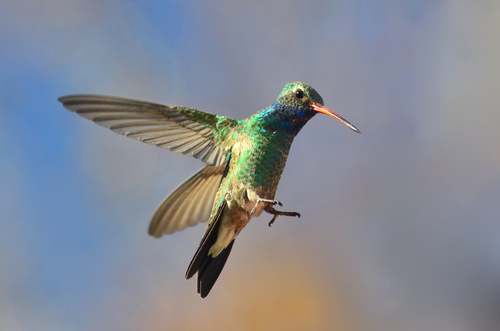
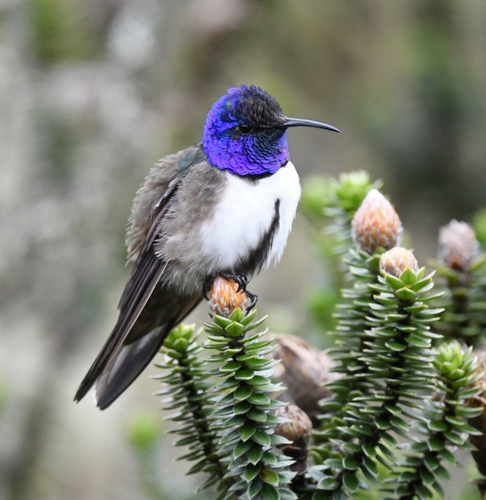
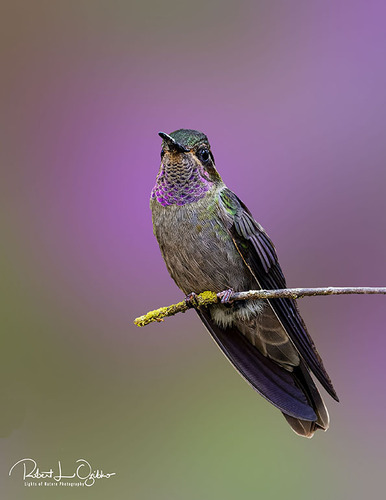
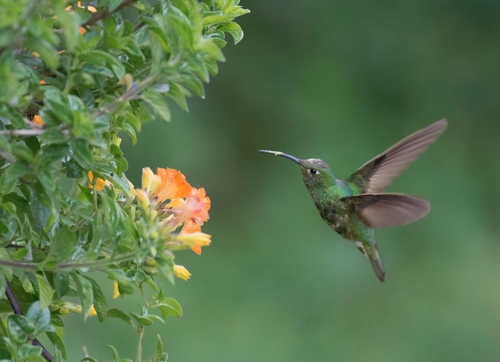
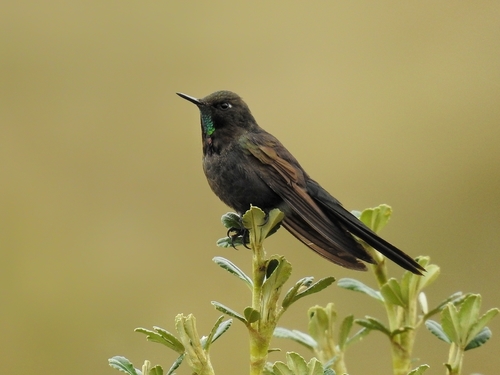
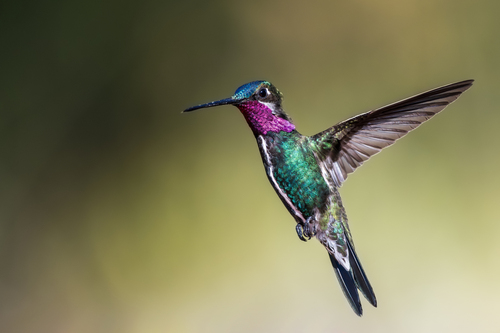
The stripe-breasted starthroat (scientific name Heliomaster squamosus (Temminck, 1823)) measures 11.2 to 12.4 cm (4.4 to 4.9 in) long and weighs 5 to 6.5 g (0.18 to 0.23 oz). Both sexes share several physical traits: a long, slightly curved downward black bill, a white streak behind the eye, a white "moustache", and a forked tail. The female's tail is less deeply forked than the male's. Breeding-plumage males have bronzy green upperparts and an iridescent green crown. They have a glittering violet gorget with flaring sides, greenish-black underparts with a white stripe running down the center, black central tail feathers, and dark blue-green outer tail feathers. After the breeding season, the male's throat molts to grayish feathers with black spots. Female upperparts match those of breeding males. Female throat feathers are blackish green with white edges. Their chest and belly are grayish with a central white stripe, and their flanks are greenish. Females have green tails; the outer tail feathers have a steel blue band near the tip and white tips. The stripe-breasted starthroat is distributed in eastern Brazil, ranging from Pernambuco in the north south to São Paulo state. It has also been recorded as a vagrant in Iguazú National Park, Argentina. It lives in forest and savannah habitats at elevations between sea level and 800 m (2,600 ft).