About Heliomaster longirostris (Audebert & Vieillot, 1801)
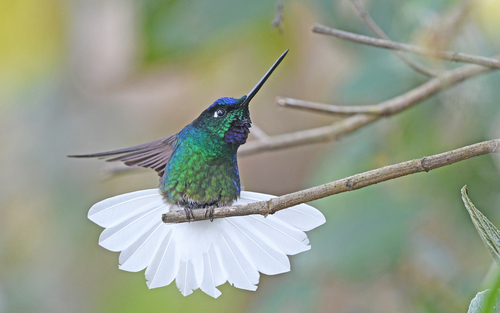
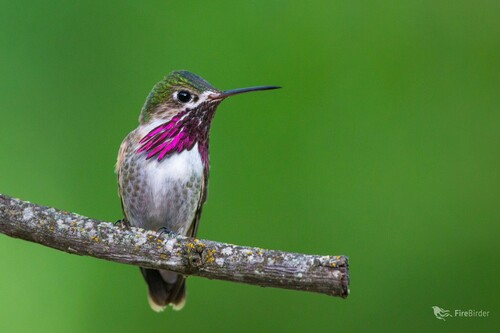
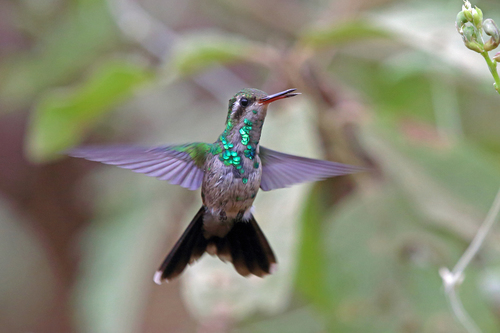
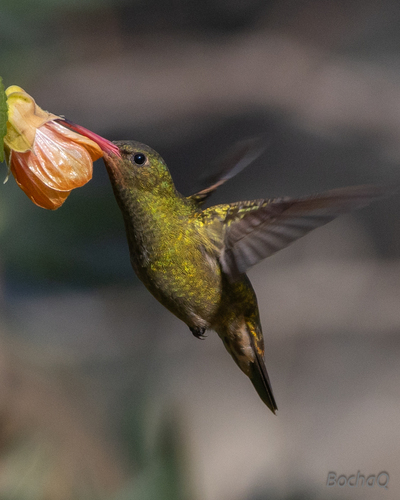
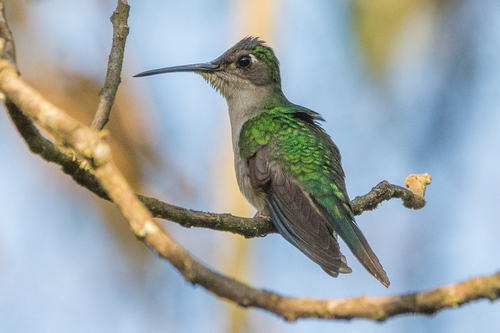
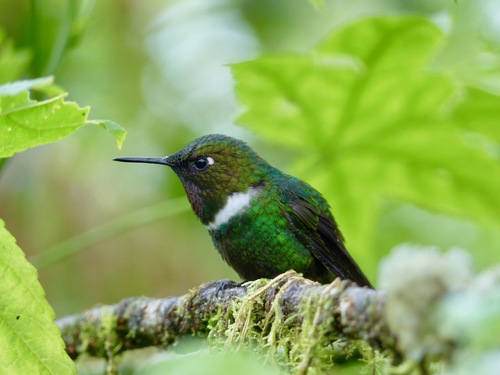
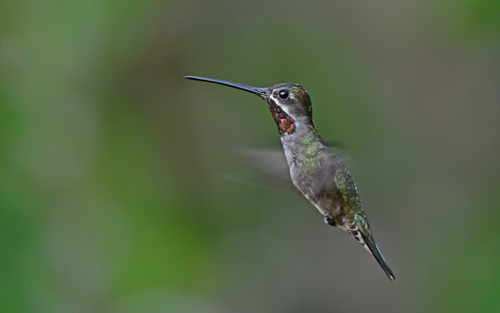
The long-billed starthroat, Heliomaster longirostris (Audebert & Vieillot, 1801), is 11 to 12 cm (4.3 to 4.7 in) long. Males weigh 5.5 to 7.1 g (0.19 to 0.25 oz), while females weigh approximately 6.5 g (0.23 oz). All subspecies of both sexes have a long, almost straight black bill, and a small white spot behind the eye. Males of the nominate subspecies have a glittering blue to greenish blue crown. The rest of their upperparts are dark bronzy green, with a white stripe running down the center of the rump. Below the crown, the face is black, with a white malar stripe below the black area. The tail is fairly short and square-tipped; the tail feathers are bronzy green near the body and black further from the body, and the outer two or three pairs of feathers have white tips. The nominate male's chin is black, its gorget is dark metallic purple, its breast is gray with bronzy green sides, its lower breast and belly are dull white, and its undertail coverts are gray with white edges. Nominate females are very similar to males, but the blue crown color is much reduced or entirely absent, and the gorget is narrower and dusky gray. Subspecies H. l. pallidiceps has a more greenish blue crown than the nominate, and its breast sides are golden bronze. H. l. albicrissa is identical to the nominate subspecies except that its undertail coverts are mostly to entirely white. Regarding distribution and habitat, the northernmost subspecies is H. l. pallidiceps, which occurs from southern Mexico through Belize, Guatemala, Honduras, and El Salvador into Nicaragua. The nominate subspecies, H. l. longirostris, is the most widespread. It is found from Costa Rica through Panama, south into South America as far as eastern Peru and eastern Bolivia, east through the Guianas well into Brazil, and also occurs on Trinidad. H. l. albicrissa has a restricted range in western Ecuador and northwestern Peru. The species lives in a variety of humid semi-open landscapes, including woodland edges, isolated woodlands, pastures with scattered trees, gallery forest, and secondary forest. It avoids the interior of closed-canopy forest. It occurs in lowlands and foothills, with an elevation range from sea level up to about 1,500 m (4,900 ft).