About Heliomaster constantii (Delattre, 1843)
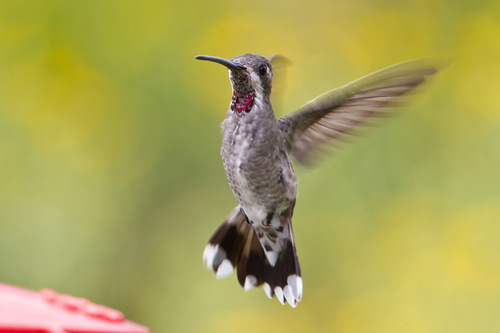
The plain-capped starthroat (scientific name Heliomaster constantii (Delattre, 1843)) measures 11 to 13 cm (4.3 to 5.1 in) in length. Males weigh about 7.4 g (0.26 oz) and females weigh about 7.2 g (0.25 oz). For all subspecies, both sexes share a long, almost straight, black bill and a white streak behind the eye. The sexes have essentially identical plumage. The nominate subspecies has metallic bronze green upperparts with a wide white streak on the rump, and its crown is less metallic than the rest of its upperparts. Much of its face is dusky, marked with a wide white "moustache". Its chin ranges from sooty to blackish, and its gorget ranges through several shades of bright metallic red to purplish red. Its underparts are brownish gray with a white belly. Its undertail coverts are pale gray with wide white tips, and its flanks have a large tuft of white feathers. The central pair of its tail feathers are bronze green with dusky ends, and the rest of the tail feathers are bronze green with extensive blackish at the ends and white edges on their inner margins. Immature plain-capped starthroats have a dark sooty brown throat with grayish white margins on the throat feathers. Subspecies H. c. pinicola is similar to the nominate subspecies, but has paler underparts and a smaller gorget. The underparts of H. c. leocadiae are paler than the nominate's underparts but darker than those of H. c. pinicola, and its gorget is more pink than red. Three subspecies have distinct ranges. Subspecies H. c. pinicola is the northernmost, found in Mexico from Sonora south to Jalisco. H. c. leocadiae occurs in southwestern Mexico and western Guatemala. The nominate H. c. constantii ranges from El Salvador through Honduras and Nicaragua into northwestern Costa Rica. H. c. pinicola also strays to Arizona, where it was first recorded in 1969 and by 2022 was being seen almost annually. The species lives in a variety of arid to semiarid landscapes, including the interior and edges of mature forest, thorn forest, scrublands, gallery forest, secondary forest, and open areas with scattered trees.