About Heliofungia actiniformis (Quoy & Gaimard, 1833)
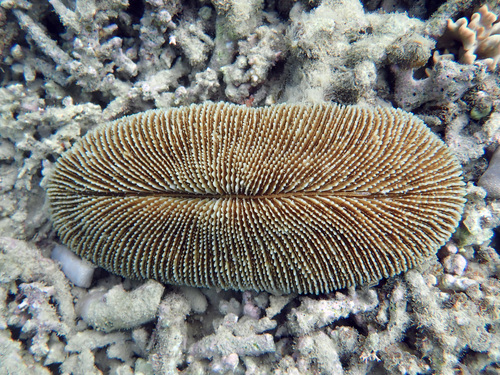
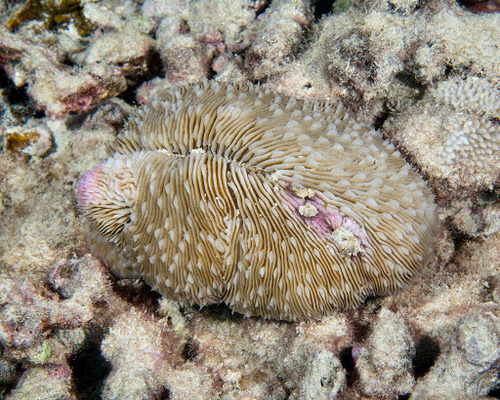
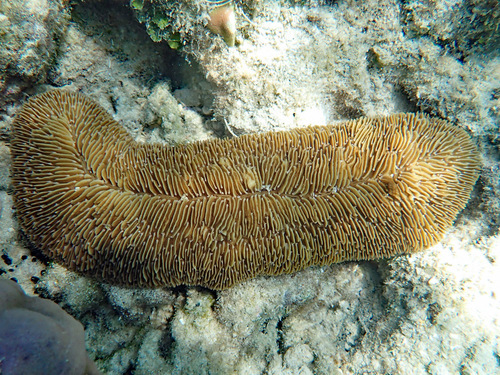
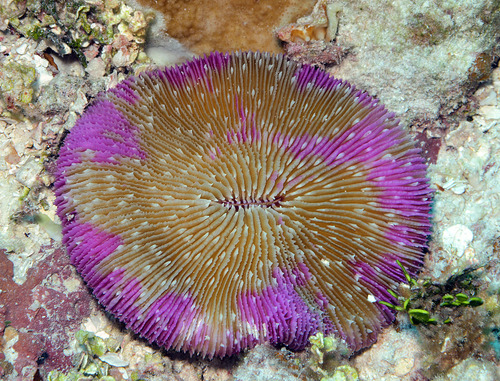
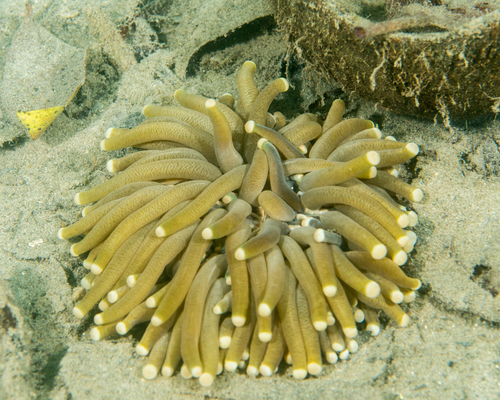
Heliofungia actiniformis is sessile and fixed to the substrate when it is a juvenile, but becomes detached and free-living when it reaches adulthood. It has a circular or oval shape, reaching up to 20 centimetres (8 in) in diameter and 7 centimetres (3 in) in height. Its stony skeleton, called a corallum, is thick and solid. The stony ridges on the skeleton, known as septa, are arranged in several orders. Earlier order septa are larger than later order ones, and have more prominent lobe-like or triangular teeth. All septa have a granular texture, and continue onto the underside of the corallum as fine ridges called costae. There is an attachment scar in the center of the corallum's underside. The polyp is thick and fleshy, with a single mouth surrounded by thick tentacles that have knobs at their ends. The tentacles are almost always extended, and give the coral a superficial resemblance to a large sea anemone. Heliofungia actiniformis is native to the eastern Indian Ocean, the central Indo-Pacific region, the northwestern, northern and eastern coasts of Australia, Japan, the South China Sea, and the island groups of the West Pacific. It lives at depths between about 1 and 25 metres (3 and 82 ft), and most commonly occurs on reef slopes or reef flats. H. actiniformis is a zooxanthellate coral, meaning it hosts tiny photosynthetic symbiotic organisms within its tissues; these symbionts meet most of the coral's metabolic needs during the day. The coral also catches and feeds on zooplankton using its tentacles. In addition to sexual reproduction by spawning, where it releases eggs and sperm into the water column, this coral can sometimes produce a new polyp through budding. The polyps of H. actiniformis act as a micro-habitat for a wide range of associated fauna, from cleaner shrimps to juvenile fishes.