About Heliodoxa leadbeateri (Bourcier, 1843)
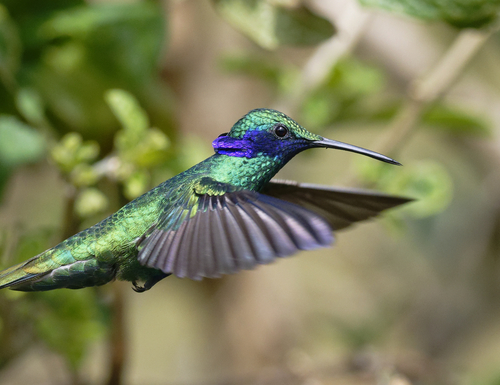
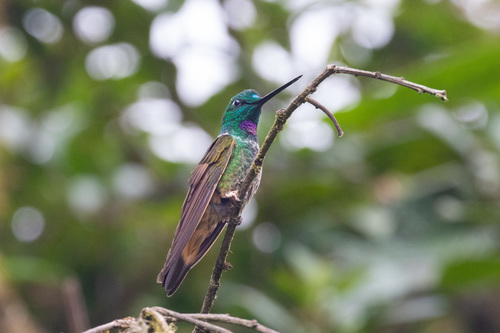
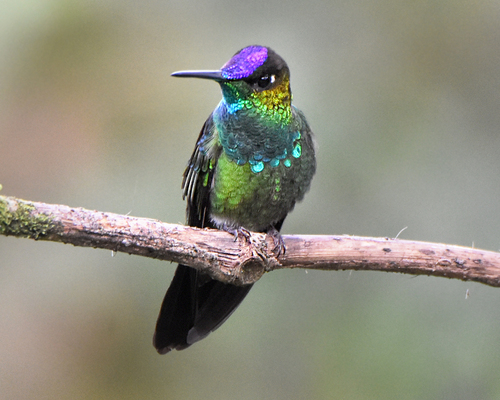
The violet-fronted brilliant, Heliodoxa leadbeateri, measures 11 to 13 cm (4.3 to 5.1 in) in total length. Males weigh 7.1 to 8.5 g (0.25 to 0.30 oz), while females weigh 6.6 to 7.5 g (0.23 to 0.26 oz). Both sexes share several physical traits: a medium-length, nearly straight black bill, a white malar streak, a small white spot behind the eye, and a forked tail. The female’s tail is less deeply forked than the male’s. Different subspecies have distinct plumage patterns. Males of the nominate subspecies H. l. leadbeateri have bronzy green upperparts, a glittering blue forehead, and a coppery neck. They also have a glittering emerald green gorget, and dull bronzy green breast and belly. Their tail plumage follows this pattern: the central pair of tail feathers is bronzy green, the next pair is steel blue with bronze tips, and the remaining tail feathers are dark steel blue. Females of the nominate subspecies have coppery green upperparts with a glittering green forehead. Their underparts are white that transitions to buffy on the belly, and their throat and breast are heavily spotted with glittering green. All tail feathers of nominate females have white tips. Males of subspecies H. l. parvula have a violet forehead and a paler, duller belly than nominate males. Their central tail feathers are lighter and greener than the nominate’s, while the rest are more blackish. Female H. l. parvula have a cinnamon buff background color on their belly. Males of H. l. sagitta have a blue forehead and a bluish breast; their remaining underparts and tail match those of H. l. parvula. Female H. l. sagitta have a blue patch on the crown and an almost white belly. Males of H. l. otero have less coppery upperparts than the nominate subspecies; female H. l. otero have a brownish belly and little to no glittering color on the forehead. Each subspecies of violet-fronted brilliant has a distinct geographic range: H. l. leadbeateri is found in the Venezuelan Coastal Range, between the states of Falcón and Miranda; H. l. parvula occurs in the Andes of western Venezuela, Serranía del Perijá along the Venezuela-Colombia border, most of the Eastern Andes of Colombia, and the northern end of the Central Andes; H. l. sagitta lives on the eastern slope of the Ecuadorean Andes, extending south into Peru as far as the Department of Pasco; H. l. otero ranges along the eastern slope of the Andes from central Peru into northwestern Bolivia, reaching Cochabamba Department. The violet-fronted brilliant inhabits a variety of landscapes, primarily in the tropical and subtropical zones. It occurs mainly in the interior and edges of pre-montane rainforest and cloudforest, but is also found in scrub, clearings, secondary forest, and coffee plantations. Its elevational range spans between 400 and 2,400 m (1,300 and 7,900 ft).