About Heliodoxa jacula Gould, 1850
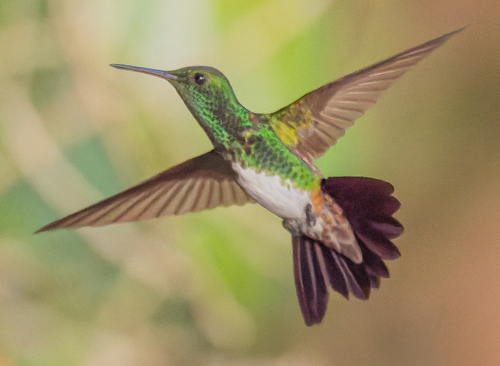
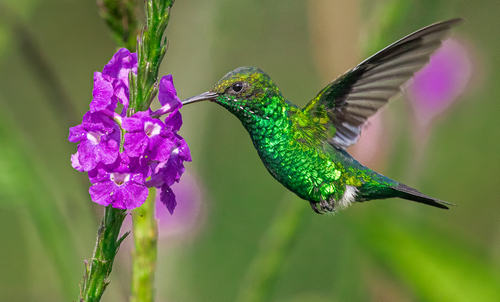
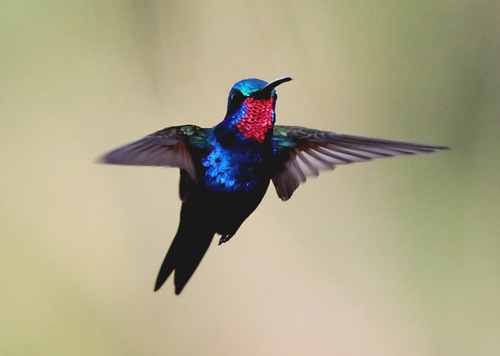
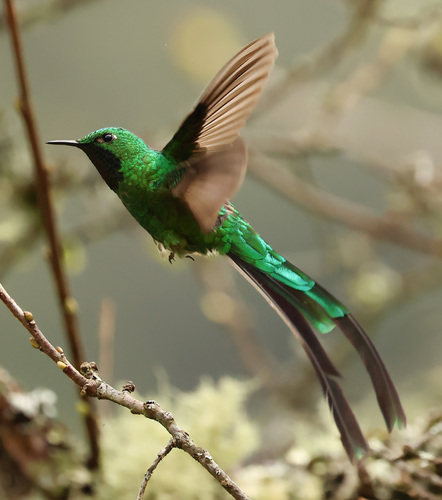
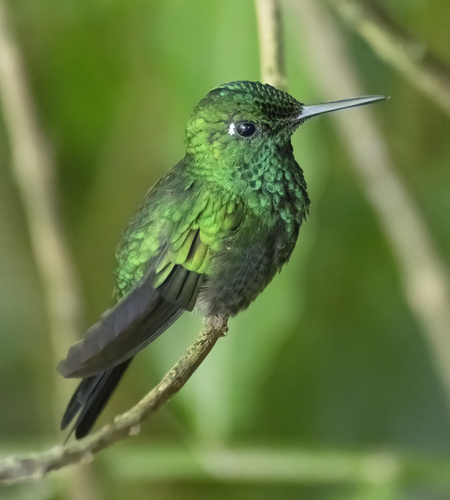
Male green-crowned brilliants (Heliodoxa jacula) are 12 to 13 cm (4.7 to 5.1 in) long; females are 10.5 to 12 cm long and weigh 0.37 to 0.42 oz, with one recorded female weighing 7.4 g (0.26 oz). Across all subspecies, both sexes have a white spot behind the eye and a forked tail; the female's tail fork is less deep than the male's. Adult males of the nominate subspecies have a glittering green to blue-green head and breast, with a small metallic violet-blue patch on the throat. Their upperparts and belly are bronzy green, their vent area and thighs are white, and their tail is blue-black. Adult females have a blue-green head that is not shiny like the male's, a short white malar stripe, and whitish underparts heavily spotted with green that merge on the flanks. Their tail is black, and the outer tail feathers have white tips. Immature males have dull bronzy green crowns and underparts, a bright buff chin and malar area, and a shallowly forked tail. Immature females have a bright buff throat and duller green underpart spots than adult females. Subspecies H. j. henryi is larger than the nominate. Males of this subspecies have more brilliant glitter on their heads, and their plumage is greener with little or no blue. Females have more white on their underparts, and distinct green spots extend all the way onto their flanks. Males of H. j. jamersoni are much duller on the head and breast than the nominate, with shorter tails that have a green gloss on the central feathers.
The nominate subspecies of green-crowned brilliant occurs from Panamá Province in eastern Panama into Colombia, where it lives in all three Andean mountain ranges. H. j. henryi is found further north, ranging from Costa Rica south and east into Panama as far as Coclé Province. H. j. jamersoni occurs from Colombia's Nariño Department (and possibly further north in Cauca Department) south along the western slope of the Ecuadorian Andes, at least as far as El Oro Province. The green-crowned brilliant lives in a variety of landscapes, including the interior, edges, and clearings of humid sub-montane and montane forest, mature secondary forest, and gardens. Its general elevation range in Costa Rica is 700 to 2,200 m (2,300 to 7,200 ft), though it sometimes occurs as low as 100 m (330 ft). In Panama it is usually found between 500 and 2,100 m (1,600 and 6,900 ft); in Colombia between 300 and 1,700 m (980 and 5,600 ft); and in Ecuador between 500 and 1,550 m (1,600 and 5,100 ft), with records of occurrence as low as 300 m (980 ft).