About Heliodoxa aurescens (Gould, 1846)
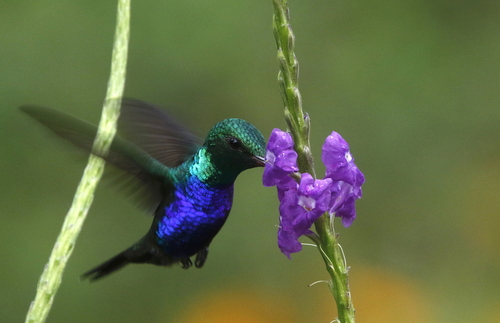
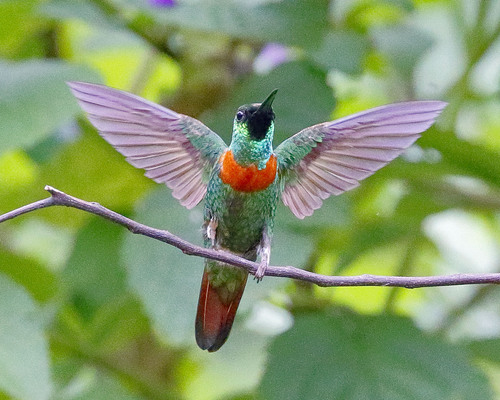
Heliodoxa aurescens measures 11 to 12 cm in total length, with an average body weight of approximately 6.2 grams. This species is sexually dimorphic, with small differences in plumage and bill length between males and females. Both sexes possess a narrow band of glittering purplish-blue feathers at the front of the head; this feature is underdeveloped in immature individuals. The relatively short, straight bill ranges from black to dark in color and is considered unspecialized; irises are brown, and the tarsi are black. The tail is forked: the central pair of tail feathers is bronze-green, while all other tail feathers have chestnut edges and bronze-green tips. Undertail coverts are deep fawn, and the wings are purplish-brown. This species shows minimal plumage variation across its wide range, and the observed variation is not tied to geographic location. Among specimens examined by Peter Cotton, average wing length was 60.5 mm and average exposed culmen length was 18.5 mm. The original specimen described by Gould had a 2.5 cm bill and a 31.75 mm tail. The average genome c-value for this species, calculated from four specimens, is 1.1135 pg, with individual values ranging from 1.045 to 1.162 pg. Males have shining grass-green upperparts; the sides of the neck and lower throat are glittering golden green, bordered by a distinctive orange to rufous breast band. The chin, lores, and upper throat are velvety black, and the rest of the underparts are shining green. Females are generally similar to males, but their plumage is duller and they have a green crown. Females have a slightly larger bill than males, with a Lovich-Gibbons ratio of 0.030. Female chin feathers have buff tips, the throat is greyish with green discs, and females have a buff to chestnut malar stripe running from the base of the bill toward the neck.
The full extent of Heliodoxa aurescens's distribution is not fully confirmed. This wide distribution is unusual for the genus, as other Heliodoxa species usually have very narrow, restricted ranges, most often at higher elevations in the Andes. Heliodoxa aurescens occurs across a broad area at elevations from 250 m to 1150 m, and has been recorded as high as 1450 m. Its range extends from a northern boundary in southern Venezuela, south through central Ecuador and Peru, to a southern boundary in Bolivia. It occupies a large area of north-western Brazil, with the eastern edge of its range reaching the State of Para. The species's known range has expanded multiple times since it was first formally described. When first described, Gould suggested the species occurred east of the Andes in Ecuador, Peru, and Brazil (as referenced in Zimmer). The first recorded Venezuelan population was documented in 1941, and at that time the southern limit of the range was thought to be La Pampa in Peru. The species was detected in Bolivia in 1984, and in the Brazilian state of Mato Grosso in 2004. Apart from documented range expansion, the species is considered sedentary.
Heliodoxa aurescens is typically found in the understorey of lowland humid tropical forests, most often near streams, and only rarely occurs at forest edges. In Brazil, it has been observed in tall forest affected by logging, and has been seen feeding at flowers in the canopy of a small patch of semi-deciduous forest surrounded by terra firme. Peter Cotton observed the species in both varzea floodplain forest and terra firme upland forest, but did not find it in riverine vegetation. Another Brazilian study recorded the species in terra firme during both the wet and dry seasons, but only found it in várzea during the dry season. A one-year survey in Colombia found Heliodoxa aurescens only in old secondary growth, and never in young secondary growth or undisturbed understory; however, a later survey observed the species in primary forest. In Peru, the species has been found in both mature floodplain forest and terra firme.
Very little is known about the reproductive biology of Heliodoxa aurescens. Breeding is thought to occur between June and September. Females incubate a clutch of two eggs. Two examined female specimens had well-developed gonads in February and April, while a single male specimen collected in February had small gonads.