About Heliconius melpomene (Linnaeus, 1758)
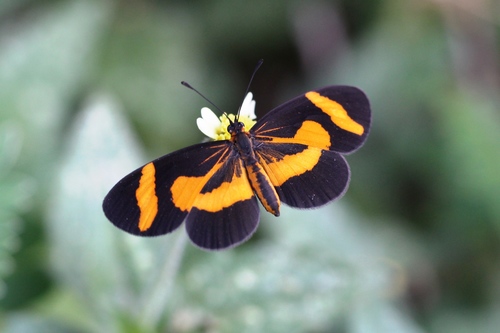
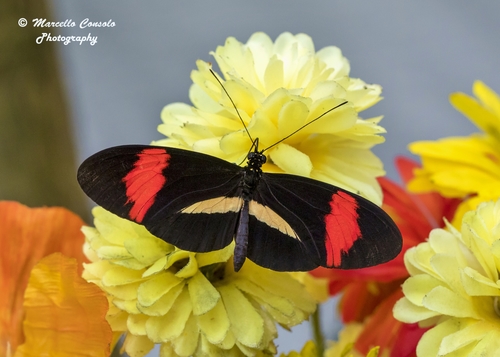
Commonly called the postman butterfly, Heliconius melpomene is primarily black with either red or yellow bands across its forewings. It has large, long wings that measure 35 to 39 millimeters. This species is poisonous, and its red wing patterns are an example of aposematism. It closely resembles the related species Heliconius erato, but two features on the underside of the hind wings help distinguish the two. H. erato usually has four red dots where the wing attaches to the thorax, while H. melpomene usually has three. In regions including Mexico, Central America, and the west coast of Colombia and Ecuador, the yellowish-white stripe on the hind wing underside reaches the wing margin in H. erato, but ends before reaching the margin in H. melpomene.
Many geographical races, subspecies, and morphs of H. melpomene exist across Central and South America. Linkage mapping studies of this geographic variation in wing patterns have found that the patterns are associated with a small number of genetic loci called genomic "hotspots". These color pattern hotspot loci are homologous between co-mimics H. erato and H. melpomene, which strengthens evidence for parallel evolution of morph patterns between the two species.
H. melpomene ranges from Central America to South America, and occurs especially on the slopes of the Andes mountains. It most commonly lives in open terrain and forest edges, and can also be found near the edges of rivers and streams. It shares its range with other Heliconius species, and is usually less abundant than those other species.
For Lepidoptera, pollen is an rarely used but efficient source of protein. When adult H. melpomene forage for pollen, they accumulate pollen on the end of their proboscis, where the pollen grains remain for long periods of time. These grains are transferred to the stamen of another plant that the butterfly visits during foraging. Although many plants within the range of H. melpomene provide suitable nutrients, the butterfly only visits a small number of these species. This makes the butterfly an efficient pollinator for the flowers it does visit, as there is a low chance that a plant will receive the wrong type of pollen.
The eggs of H. melpomene are yellow, and measure approximately 1.5 by 1 millimeter. They are mostly laid singly, and very rarely laid in small clusters, on the young leaves of Passiflora plants. Caterpillars live in groups of two to three individuals, and are white with black spots. Pupae are spiny and dark brown. Adult butterflies have black bodies with bright yellow or orange wing patterns. Female H. melpomene produce oocytes continuously throughout their life, which is made possible by the high nutrient diet they get from eating pollen. Closely related Heliconius species have a reported maximum lifespan of six months, and H. melpomene likely lives a similar length of time.