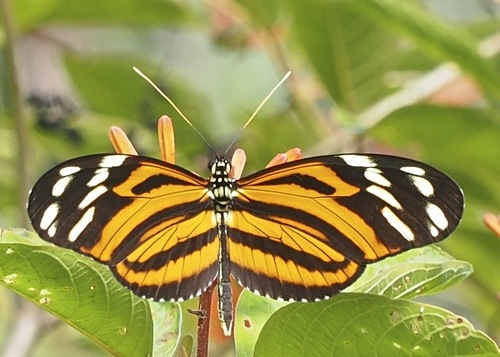
About Heliconius ismenius Latreille, 1817
Heliconius ismenius Latreille, 1817 follows the standard four-stage butterfly life cycle, starting as an egg, developing into a larval caterpillar, pupating, and maturing into an adult butterfly. Females lay eggs singly or in pairs, spread out on separate leaves in specific locations on their host plants. The small yellow eggs measure approximately 1.3 mm in height by 0.8 mm in width. Mature larvae grow to around 2 cm long and have distinct coloration: an orange head and anal plate, and a white body covered all over with black spots. As recorded by Beltran, H. ismenius pupae are brown with a strongly bowed thorax and five pairs of black spines on the abdomen. On average, the dorsal surface of the pupa bears three gold-colored spots. Adult butterflies have short black spines covering their entire antennae, along with short horns on the head. Heliconius ismenius feeds on specific host plants that it uses throughout its lifetime. Most commonly used host plants belong to the genera Granadilla and the Passiflora subgenus Distephana. In Costa Rica alone, this species feeds on Passiflora platyloba, P. ambigua, P. alata, and P. pedata. This species occurs in rainforests, where it is found at elevations no higher than 1,500 meters. At night, adult H. ismenius typically gather in communal groups 3 to 10 meters above the ground. These groups usually form along forest edges, on branches and tendrils of host plants and trees.