About Helicolenus dactylopterus (Delaroche, 1809)
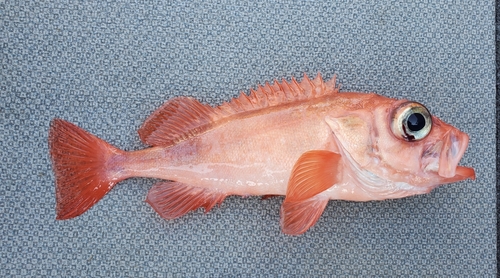
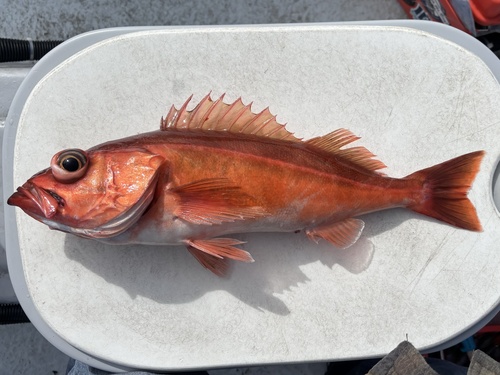
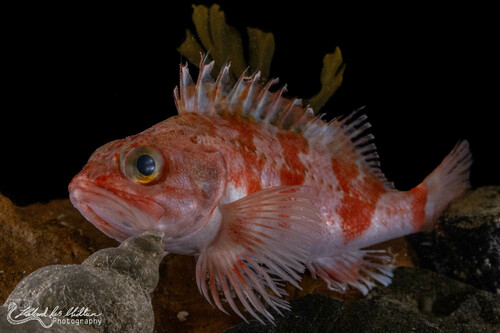
Blackbelly rosefish, the common name for Helicolenus dactylopterus (Delaroche, 1809), is a robust fish with a large head that carries the spination characteristic of the Helicolenus genus, and it has no tabs or tentacles. The profile of its nape has a relatively steep incline. Both its jaws hold villiform teeth, and the inside of its large mouth is dark colored. Its dorsal fin has 11 to 13 spines (most often 12) and 10 to 14 rays (most often 11 to 13); its anal fin has 3 spines and 5 rays; and its pectoral fin has between 17 and 20 rays. It has 55 to 80 vertical rows of ctenoid scales, and its lateral line is made up of tubular scales. The chest, cheek and maxilla are usually covered in scales, while the snout and ventral part of the head are not scaled. This species usually has 25 vertebrae. Its gill rakers are well developed, with 7 to 9 on the upper gill arch and 16 to 21 on the lower gill arch. Its body color is variable: the back and sides are red, and the belly is pink. It has 5 to 6 dark bands located below the anterior, middle, and posterior dorsal spines; additional dark bands sit below the soft dorsal rays and at the base of the caudal fin. A Y-shaped dark bar sits between the soft dorsal and anal fin, and there is usually a dark blotch on the posterior part of the spinous dorsal fin. Like other scorpionfish species, the spines of the blackbelly rosefish contain toxic venom, and these spines have been reported to cause injuries to humans. Little research has been done on the venom this species produces. This fish is widely distributed across the Atlantic Ocean. In the western Atlantic, its range extends from Nova Scotia to Venezuela. In the eastern Atlantic, its range extends from Iceland and Norway to South Africa, and it can also be found in the Azores, Madeira, Canary Islands, and throughout the entire Mediterranean Sea. Blackbelly rosefish have intraovarian gestation, with internal fertilization. In the Western Atlantic, free spermatozoa are found primarily in resting ovaries from July through early December, with peak presence between September and November. There is a 1 to 3 month delay before fertilization occurs, because oocyte development does not start until December. Observations of early-celled embryos (the most advanced development stage documented) and postovulatory follicles between January and April show that oocyte development proceeds rapidly. Females can store sperm within their ovaries, which allows them to spawn multiple batches of embryos. These embryos are enclosed in a gelatinous matrix that is secreted into the ovarian cavity. This species has a zygoparous form of oviparity, which falls at an intermediate position between oviparity and viviparity. Its larvae and juveniles are pelagic.