About Helicodonta obvoluta (O.F.Müller, 1774)
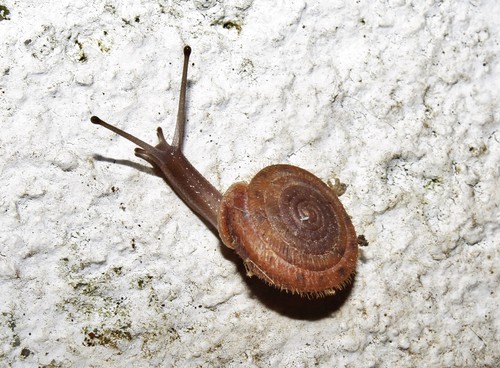
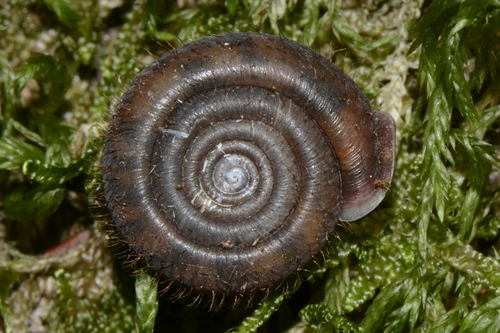
Juvenile and young adult shells of this snail are typically covered with 1 mm long hairs, which are often absent in older specimens. The dark-brown shell has a flat upper side, a very slightly sunken spire, and a wide umbilicus. The peristome is flattened both above and below. The white everted lip is slightly thickened at its center, forming a callus in the palatal and parietal regions, which causes the shell opening to appear divided into three embayments in some specimens. The shell diameter ranges from 10 to 15 mm, and the shell height ranges from 5 to 7 mm. The average weight of an adult living individual of this species is 414.2±6.7 mg. Unlike many other snail species in the superfamily Helicoidea, Helicodonta obvoluta does not have love darts. The species' main distribution range stretches from northwestern Spain across France, Switzerland, Liechtenstein, Belgium, Luxembourg, the Netherlands, southern and central Germany, Austria, the Czech Republic, Slovakia, Poland, Hungary, Slovenia, Croatia, Italy, Bosnia and Herzegovina, and Serbia. Isolated populations exist in southeastern England and northern Germany, which may be remnants of an earlier, more widespread distribution. The status of populations in Albania, North Macedonia, and Greece is unclear. Many authors assign these populations to the separate species Helicodonta albanica, while other authors treat this taxon as a subspecies of Helicodonta obvoluta. Helicodonta obvoluta has an average lifespan of 2 years, with a maximum recorded lifespan of 3 years. The snail is active from April to November, with daily activity concentrated in the early morning and at night. Mating in this species can last 2 to 3 hours. There are two distinct reproductive periods each year: the first in spring from April to June, and the second in autumn from August to October. Females lay eggs in clutches of 9 to 27 eggs in rotten wood, and the egg clutches are covered with a protective layer of mucus. Juveniles hatch after an incubation period of 14 to 31 days, and reach sexual maturity between 140 and 624 days after hatching. Individuals from the spring reproductive generation can reach maturity in the same year they hatch, while individuals from the autumn reproductive generation must overwinter as immature snails. Helicodonta obvoluta spends most of its life close to and inside fallen tree trunks, which provide sites for egg-laying, feeding, daytime shelter, and winter hibernation. Populations living in milder oceanic climates, such as those in Great Britain, may also hibernate within leaf litter.