About Helichrysum stoechas (L.) Moench
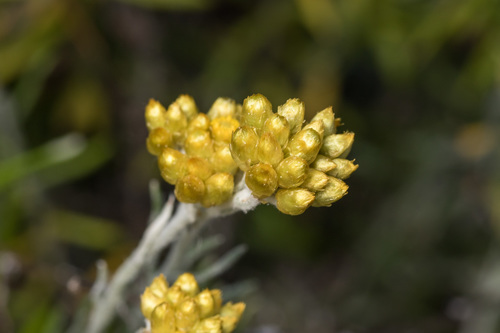
Helichrysum stoechas (L.) Moench, commonly called Mediterranean strawflower, curry plant, common shrubby everlasting, everlasting flower, or eternal flower, grows as either an annual or perennial shrub depending on its location. This species favors dry, rocky, and sandy habitats. It can reach up to 120 centimeters (47 inches) in height, and can spread to cover an area of over 1 square meter (3 feet 3 inches). It is a hermaphroditic plant with grayish green leaves, and produces small, globular yellow flowers that bloom sometimes in spring, or in July and August. Its flowers are pollinated by insects. Extracts of Helichrysum stoechas have been used in traditional medicine to treat colds, act as a nerve tonic, reduce inflammation, and speed the healing of bruises. Multiple studies have investigated the phytochemical and pharmacological properties of compounds found in the species' flowers, stems, and foliage, and these studies have confirmed that Helichrysum stoechas has an inhibitory effect on some bacteria and viruses. Because its leaves and flowers have an intense fragrance, Helichrysum stoechas is used in perfumery and aromatherapy as a fixative, in the forms of both its essential oil and floral absolute. Like other species in the Helichrysum genus, it has a warm organoleptic (sensory) profile described as sweet, caramellic hay, fruity, honey, tobacco, and tonka. Its essential oil, which has the CAS Registry Number 91845-22-6, is typically produced in Southern Europe around the Mediterranean, while its floral absolutes are produced in Egypt. The main active constituents of Helichrysum stoechas are nerol acetate, curcumin, pinene, limonene, kaempherol, quercetin, luteolin, linalool, and geraniol, alongside other flavonoids, sesquiterpenes, and hydrocarbons.