About Helichrysum pumilum Hook.fil.
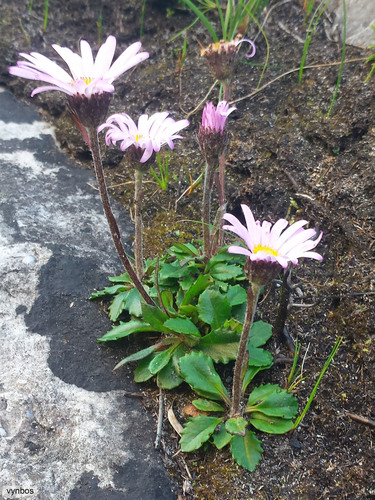
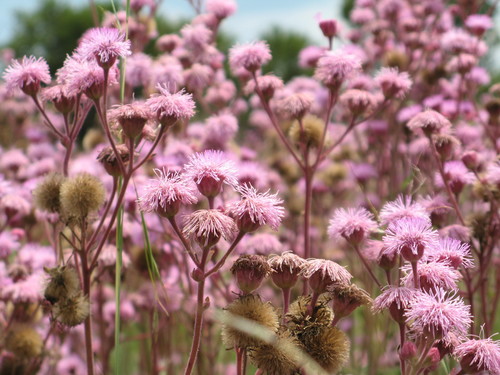
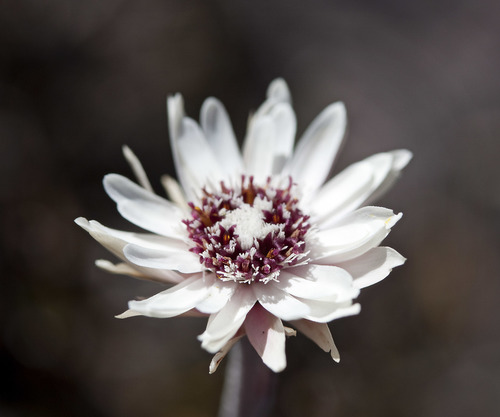
Helichrysum pumilum Hook.fil. is a low tufted perennial herb that grows to around 10 cm tall. Its leaves are linear to spathulate in shape, 15–50 mm long and 1–5 mm wide, with revolute margins. All leaves are grouped in a rosette that arises from the base of the plant. There are two recognized varieties: var. spathulatum has shorter, more spathulate leaves, while var. pumilum has longer, more linear leaves. An inflorescence rises from the basally sheathing leaves, borne on a 20–100 mm long white woolly scape that bears a few leaf-like bracts. Elliptic to linear bracts called phyllaries form a rosette around the flower head, with an appearance that resembles ray florets. Outer phyllaries are mostly white, and may be streaked with pink; inner phyllaries are white or pink. The florets are arranged as corolla tubes within the pseudanthium, are numerous, and range in colour from pink to purple. This species flowers in summer, between December and February. It can be mistaken for Celmisia saxifraga, but differs because its flower heads lack true ray florets, and its leaves are not silvery or hairy on their upper surface. This species is endemic to Tasmania, where it grows mostly in the West and Southwest of the state, with a small number of rare reported sightings in the East. Its overall range extends from buttongrass plains to sub-alpine areas, including the slopes and summits of mountain ranges. The originally described variety, H. pumilum var. pumilum, is mostly restricted to buttongrass plains with low-nutrient peaty soils, and occasionally grows into adjacent sub-alpine areas. The variety spathulatum, described by A.M. Buchanan, is restricted to the mountainous alpine areas of western and southwestern Tasmania, where it grows in shallow, skeletal soils. Helichrysum pumilum is an important food source for the critically endangered Orange-bellied parrot, alongside other seeds and flowers from low moorland and sedge-land plains. This small migratory parrot feeds on the flowers of H. pumilum towards the end of its breeding season, between late summer and early autumn.