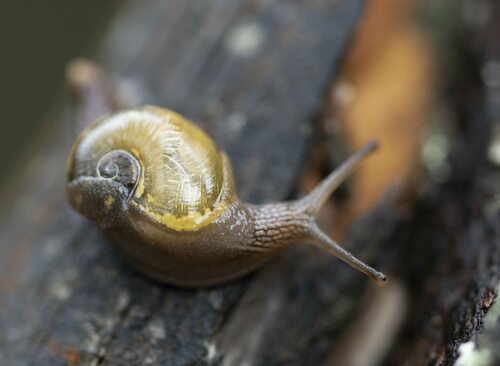
About Helicarion mastersi (J.C.Cox, 1868)
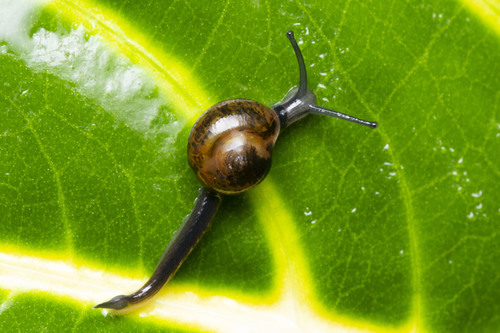
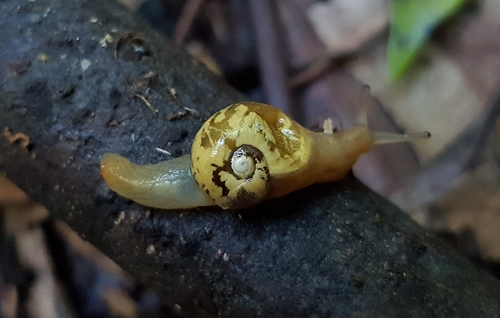
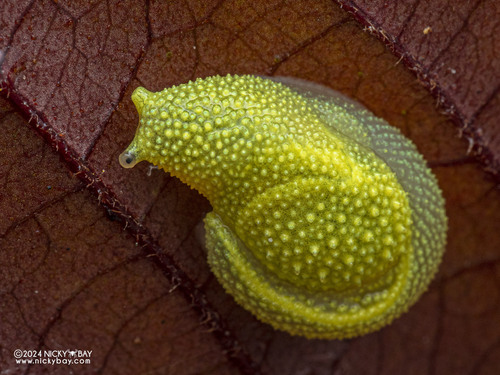
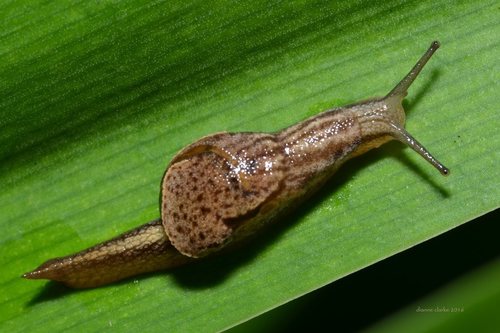
Helicarion mastersi was originally described by James Charles Cox in 1868 under the basionym Vitrina mastersi. Cox's original type description of the species' shell is as follows: The shell is depressed, very thin, smooth, transparent, extremely shiny, and marked with very fine curved striae alongside a small number of faint spiral lines. Its color is bright golden yellow, occasionally with a greenish tinge. The spire is only very slightly prominent, the apex is central, the suture is impressed and narrowly margined. There are 3 slightly convex whorls; the final whorl is rather depressed, rounded at the periphery, and rather convex across the outer half of its underside. The aperture is diagonal and lunately ovate. The peristome is simple; its right margin is slightly dilated above and in front, its left margin runs rather straightly continuous with the columella (which is strongly arcuate above), and the left margin and base are membranous and flattened. All measurements below are given in inches: greatest diameter 0.55, least diameter 0.38, height 0.17, aperture length 0.35, aperture width 0.27. The original habitat record notes the species was collected at Kiama, New South Wales by Masters. Cox noted this is a delicate, bright golden-yellow hyaline shell, related to Vitrina strangei, but easily distinguished by being much more depressed and having a membranous basal half. He also recorded that the soft animal of this species is whitish, rather than grey as in V. strangei. This species is distributed in New South Wales, Australia, and its type locality is Kiama, New South Wales, Australia. This semislug lives in closed Eucalyptus forests. It is primarily an arboreal species, but can also be found in leaf litter.