About Heliaster helianthus (Lamarck, 1816)
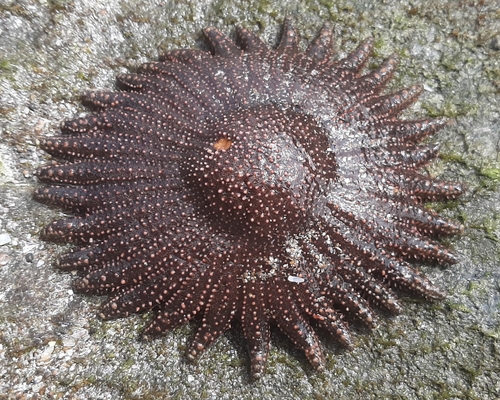
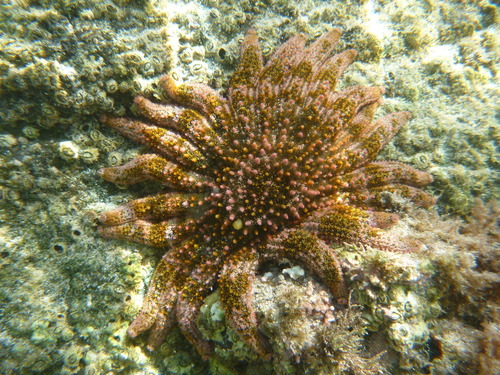
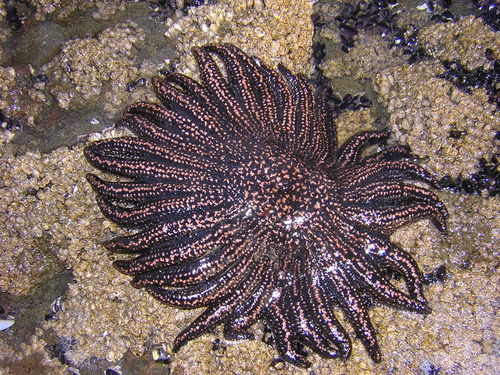
Heliaster helianthus (Lamarck, 1816) is a multi-armed starfish. It usually has between 28 and 39 arms, and typically reaches a diameter of 16 to 20 cm (6 to 8 in). Its aboral, or upper, surface is brown and has reddish tubercles, while its oral, or under, surface is white or yellowish-white. This starfish has a broad disc. The ossicles, which are plate-like components in the skin, located in the proximal parts of the arms (the sections closest to the disc) connect to the ossicles of neighboring arms via connective tissue. This connection forms inter-arm septa, which means only a small portion of each arm is fully free, and the remaining portion appears to be part of the disc.
This species occurs in the southeastern Pacific Ocean, along the west coast of South America. Its native range covers Ecuador, Peru, and Chile. It is the only member of its genus that occurs in Chile, where it is easily observed living on rocks in shallow water.
The starfish Meyenaster gelatinosus preys on Heliaster helianthus. Small H. helianthus individuals are usually eaten whole, while large individuals are immune to attack. Medium-sized individuals typically lose arms through autotomy, the ability to intentionally detach a body part. After trapping H. helianthus, M. gelatinosus everts its stomach over several of the victim's arms, which triggers the arms to autotomise in response to the predation. When this occurs, the arms do not detach at the point where the free portion of the arm begins, but detach higher up at their bases. At the same time, a split forms along the connective tissue that links adjacent arms, indicating that a layer of mutable collagen is present at this connection site.