About Helianthus maximiliani Schrad.
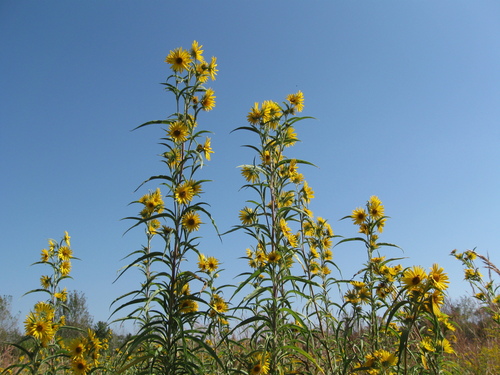
Helianthus maximiliani Schrad. is a branching perennial herb that grows from a stout rhizome, reaching heights between 0.5 and 3.0 meters (1 1/2 to 10 feet). Its rough, slender, tall, erect stems and alternately arranged leaves are covered in rough hairs. The lance-shaped leaves are narrow, rough, pointed, and folded along the midvein; on large plants, they can grow up to 30 centimeters (12 inches) long. The base of each flower head is surrounded by pointed green phyllaries, which often stick straight out and curl at their tips. The center of the flower head is filled with brown disc florets that have yellow tips, while the outer edge is lined with bright yellow ray florets 2 to 4 centimeters (1 to 1 1/2 inches) long. The flowers produce an odor similar to chocolate. This plant reproduces both by seed and by vegetative sprouting from its rhizome. Its thick rhizome is edible, and it was used as a food similar to the Jerusalem artichoke by Native American groups including the Sioux. Flower heads of this species attract insects, its fruits are eaten by birds, livestock eat parts of the plant, and its seeds are consumed by various types of wildlife. The Land Institute, a perennial agriculture research center run by Wes Jackson in Salina, Kansas, is experimenting with this species to develop a perennial oilseed grain crop that does not require annual replanting.