About Helianthemum canum (L.) Baumg.
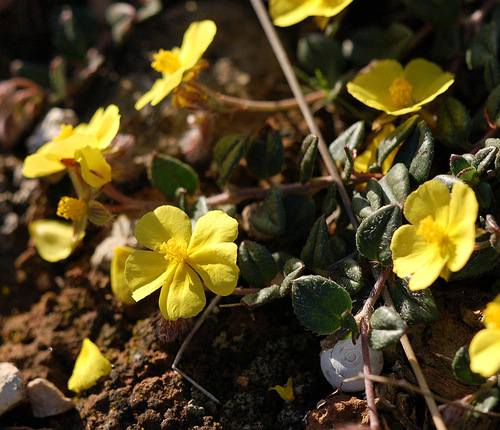
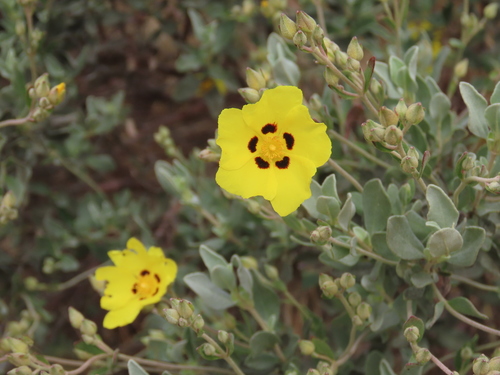
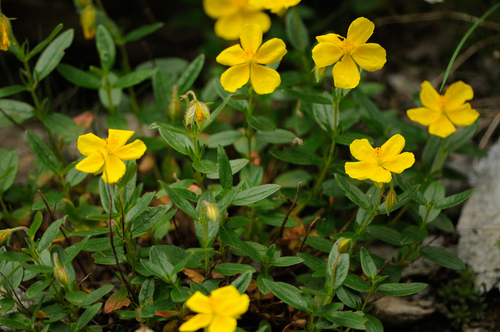
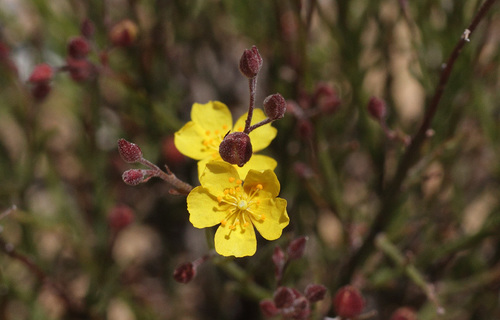
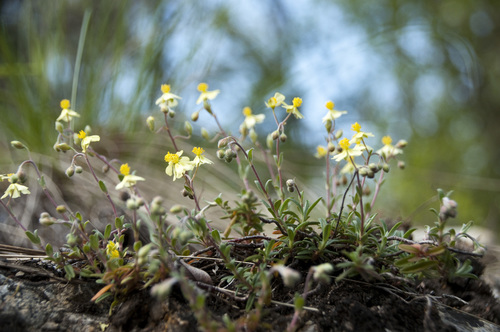
This species has the scientific name Helianthemum canum (L.) Baumg. The plant usually grows from a central stock, with numerous branches that radiate either horizontally or ascending. It does not produce stipules. Its small leaves are around 10 mm long, simple in shape, green on the upper surface, and densely hairy and grey on the lower surface. This leaf trait distinguishes Helianthemum canum from H. nummularium in regions where both species occur. Its flowers are yellow, with 5 petals that are free at the base and 5 sepals. The flowers are arranged in cymes, and each cyme generally holds 1 to 6 individual flowers. This plant is restricted to dry, rocky limestone habitats. In Britain, it always grows close to the sea, while on mainland Europe it is restricted to calcareous upland ranges such as the Alps. It can be found across several areas of Europe including France, Germany, Spain, Sweden, as well as parts of north Africa and eastern Mediterranean countries. In the British Isles, its distribution is very limited, and it only occurs in parts of the South Wales coastline and a small number of locations on Anglesey and the Great Orme.