About Helianthemum apenninum (L.) Mill.
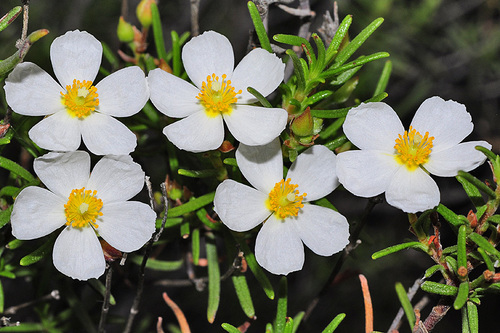
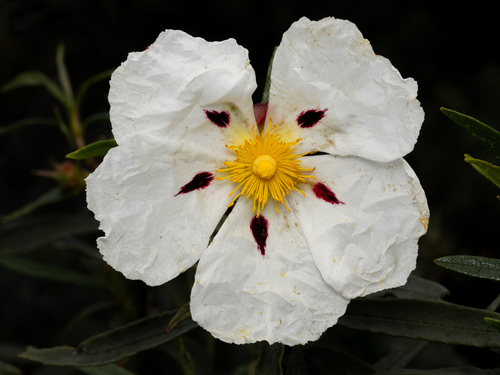
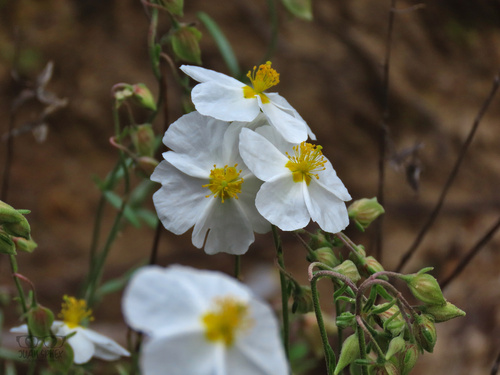
Helianthemum apenninum, commonly known as white rock-rose, is a white-flowering rock rose belonging to the family Cistaceae. It is native to the North Atlantic region, where it grows primarily in dry grassy and rocky habitats across large areas of Europe. This species is a self-supporting, semi-woody perennial shrub, reaching a maximum height of 0.5 meters, with roots that grow up to 0.3 meters deep. It is an evergreen plant that retains its foliage year-round, and it gains energy through photosynthesis as a photoautotroph. Its leaves are small, reaching around 30 mm in length, linear to lance-shaped, and grow in opposite pairs. The leaves are covered in greyish or whitish hairs, most densely on their underside, and have edges that roll under. Helianthemum apenninum flowers from March to July, and produces 5-parted (pentamerous) flowers that grow in clusters of 3 to 10 per stem. Individual flowers are white with yellow centers and yellow stamens, and can be up to 30 mm across. Of its five sepals, the three outer sepals are hairy and striped, while the two inner sepals are very small. The flowers are visited by the moth Micropterix calthella, also known as the Marsh Marygold Moth. After flowering, this plant produces dry fruits that contain seeds with an average weight of 0.9 mg. Seeds are dispersed via autochory, which is unassisted or gravity-assisted dispersion.