About Heliactin bilophus (Temminck, 1820)
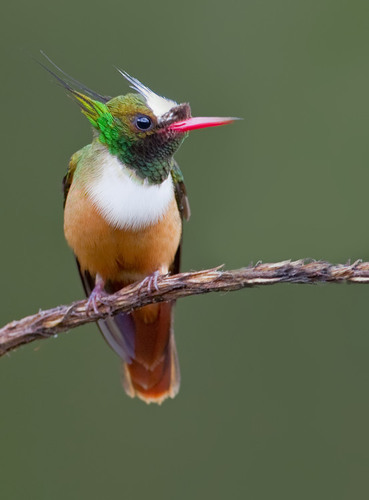
The horned sungem (Heliactin bilophus) is a small hummingbird species with a long tail. Adults measure 9.5 to 11 cm (3.7 to 4.3 in) in total length and weigh 1.8 to 2.8 g (0.06 to 0.10 oz). Both males and females have light-colored plumage, with a metallic yellow-green upperside and a white underside. The sides of the neck are also white, creating the appearance of a half-collar. Flight feathers are black-brown, and the bill and feet are black. The bill is slender, straight, and comparatively short, with an average length of 1.6 cm (0.63 in). All tail feathers are pointed; the middle four are much longer than the outer ones. The middle two tail feathers are buff in males and green in females, while the remaining tail feathers are mostly white. When viewed from below, the upper portion of the tail has a black band shaped like a V. This species has strong sexual dimorphism. Males are especially striking, with iridescent feather tufts called "horns" positioned above each eye. Each tuft is made of a row of six backwards-sloping feathers, which are fiery red at the base, golden in the middle, and golden-green at the tip. The other feathers on the upper head are shiny dark blue to blue-green, and form a low crest at the back of the head. Black non-iridescent feathers cover the throat and the sides of the head up to the ear region; the feathers in the center of the throat are very long, forming a pointed "beard" that extends above the white breast feathers. Females have plainer plumage, and lack the male's "horns", black throat/head feathers, and iridescent head feathers. A female's chin and throat are brown or yellow-buff, with darker coloring on the sides of the head, and her tail is shorter than a male's. Juvenile horned sungems resemble adult females. This species is unlikely to be confused with any other hummingbird in its range. Even without the male's unique ornaments, females can be identified by their yellow-green upperside, white underside, and long tail. Females are somewhat similar to female black-eared fairies, but can be told apart by their more yellowish upperside, more extensive white neck collar, and the different shape and coloration of their tail. The horned sungem is found across most of central Brazil: in the east, it ranges from southern Maranhão south to northern São Paulo state, and west to western Mato Grosso and Bolivia's Santa Cruz department. It has recently expanded its range into southern Amazonas and Espírito Santo, which is likely a result of deforestation and the species' ability to adapt to human-created open landscapes. It also occurs in a small area of southern Suriname, another small area in the northern Brazilian state of Amapá, and has been reported outside its typical range in Acre, in far western Brazil. A possible occurrence in Rio de Janeiro state has not yet been confirmed. The species' total range is estimated to cover 6,490,000 km² (2,510,000 sq mi). The International Union for Conservation of Nature (IUCN) classifies the species as uncommon, though other sources describe it as "locally common" or "common". It lives in a range of semi-open to open habitats, including dry and moist forests, savannas (such as the Cerrado and Caatinga), grasslands, and cultivated areas including gardens. While it is mostly found below 500 m (1,600 ft) elevation, it can occur at heights up to 1,000 m (3,300 ft).