About Helastia cinerearia Doubleday, 1843
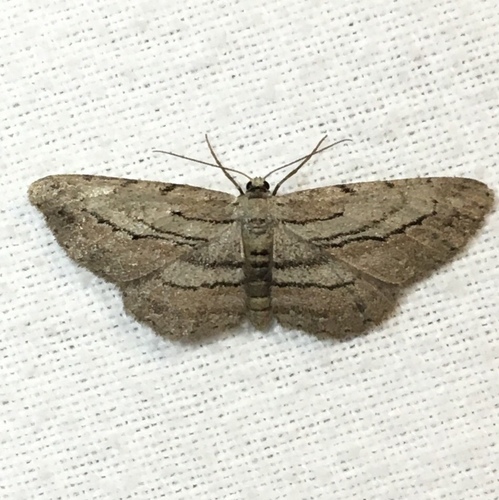
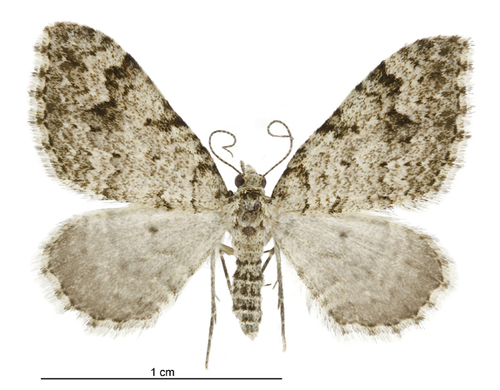
Helastia cinerearia was first described by Edward Doubleday in 1843. According to Doubleday's original description, the species' anterior wings are tapered to a point, very slightly sickle-shaped, and pale brownish-ash in color. They have many thin dark fuscous streaks, which occasionally join together to form transverse bands. One faint band sits near the wing base, while two more distinct bands lie one just before and one just past the middle of the wing; these two bands are very clear near the wing's front edge (costa), but almost disappear near the inner margin. Near the outer margin, which is slightly darker than the wing's base color, there is a thin, heavily wavy whitish streak, and a tiny white dot sits near the middle of the costa. The posterior wings are ashy-white, somewhat shiny, and marked with many indistinct fuscous streaks. On male individuals, the antennae have two thick, uneven-length comb-like branches extending from their lower surface; these branches start close together, are covered in fine silky hair, and are very short at both the base and apex of the antenna. The palps are rather long. H. cinerearia is frequently confused with four other species in the same genus: H. alba, H. christinae, H. mutabilis, and H. semisignata. This moth is endemic to New Zealand. It occurs across the North Island, South Island, Stewart Island, and has also been recorded on the Mercury Islands and Chatham Islands. H. cinerearia occupies a wide range of habitats, including urban gardens, multiple types of forest, and subalpine areas. The known larval host for this species is lichen that grows on rocks.