About Helanthium tenellum (Mart. ex Schult.f.) J.G.Sm.
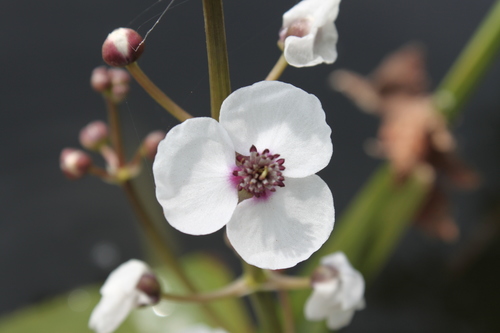
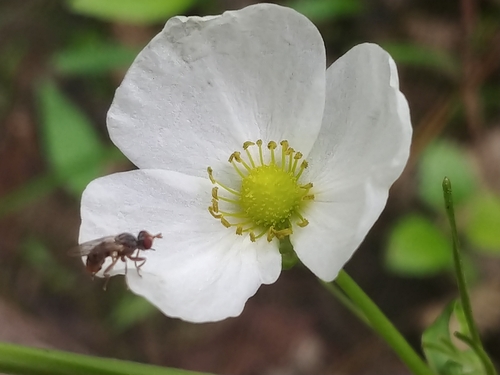
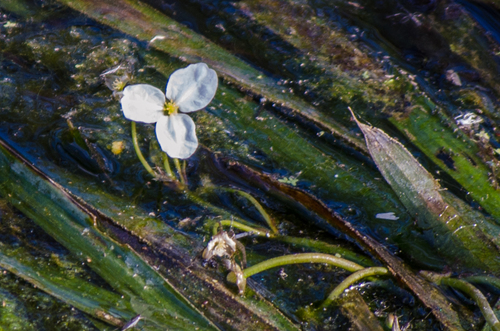
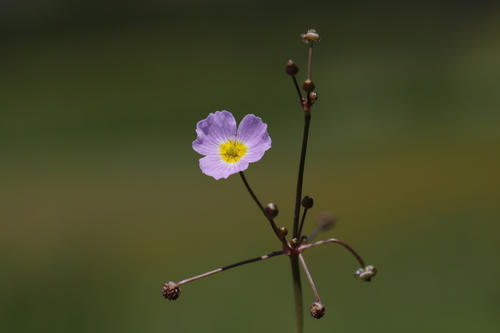
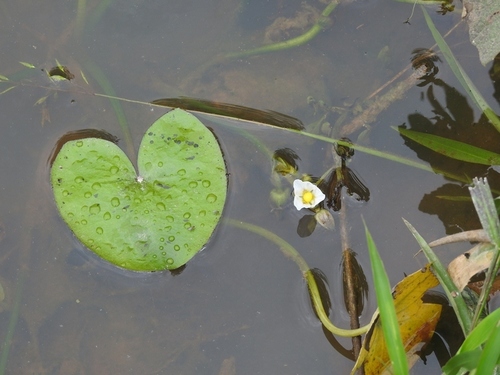
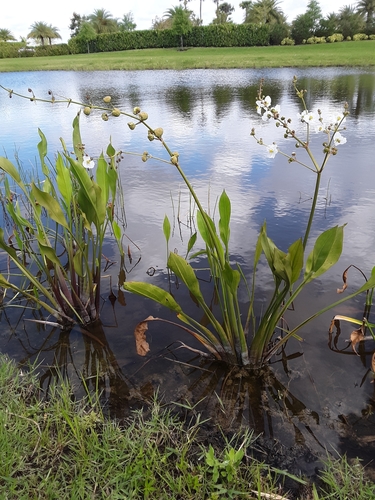
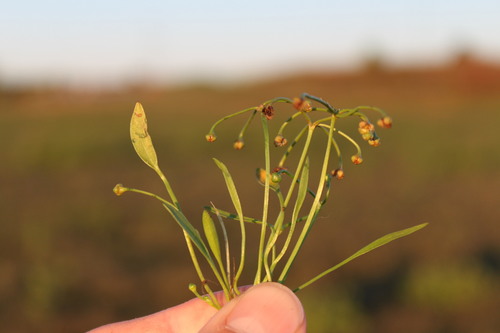
Helanthium tenellum has narrowly elliptical or lanceolate leaves. Throughout different stages of the plant's life cycle, the leaf blade is sometimes barely distinguishable from the petiole. At other life stages, the petiole is 10 to 15 times longer than the leaf blade. The leaf blade measures 1 to 4 cm long and 0.2 to 1 cm wide, with a pointed tip. The leaf base is decurrent to the petiole, and leaves have between one and three veins. The stem is thin, erect, often curved, and reaches 3 to 20 cm in length. Small individuals produce a single inflorescence at the stem tip, which is shaped like an umbel or coil. Larger plants develop racemose inflorescences made up of two whorls arranged one above the other. Bracts are free, and measure 2 to 6 mm long in the first whorl. Pedicels are 1 to 3.5 cm long. Sepals are 3 mm long, membranous, and usually marked with five fine ribs. As the fruit ripens, sepals enlarge to a maximum length of 6 mm, and fully enclose the aggregate fruit. Individual specimens can have six to nine stamens, each approximately 1 mm long. Anthers measure 0.25 mm wide by 2.25 mm long, and are three times shorter than the filaments. Plants may have sixteen to eighteen pistils. Achenes are compressed, and curved along their apical portion. They measure (0.9) – 1.1 – (1.3) mm long, are black in color, and have three lateral ribs. The base of the stylar beak sits below the level of the nutlet tip, and the stylar beak is 0.1 to 0.3 mm long. This species propagates by sending out runners, and will produce flowers when grown emersed.