About Hedycarya angustifolia A.Cunn.
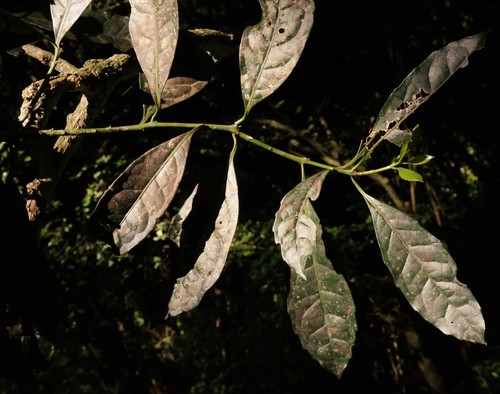
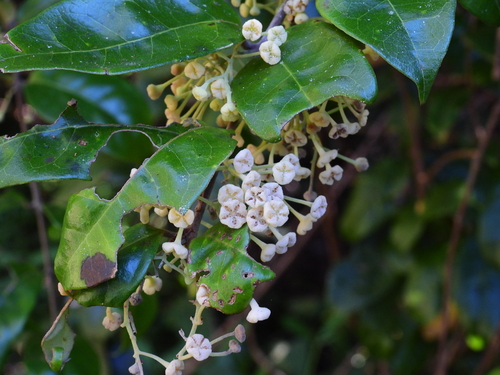
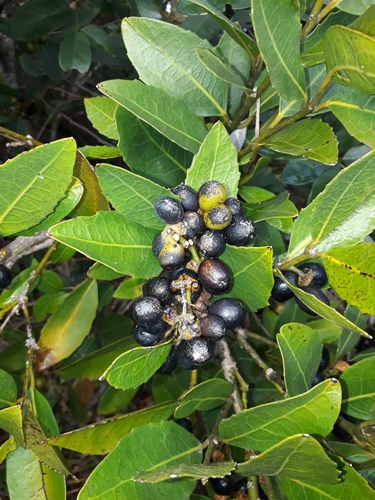
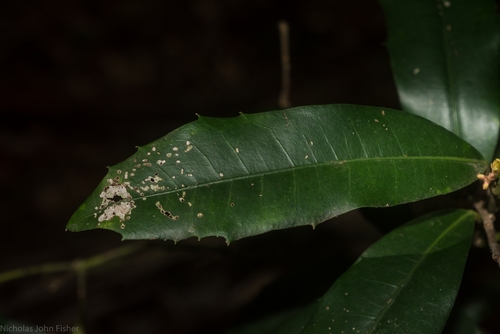
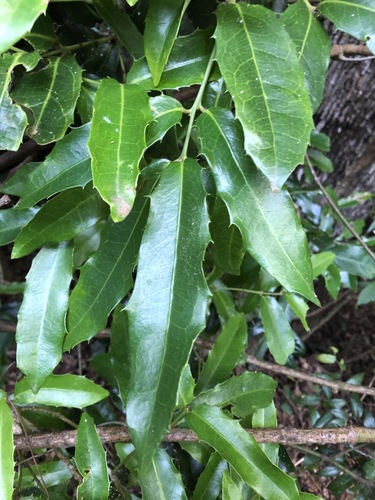
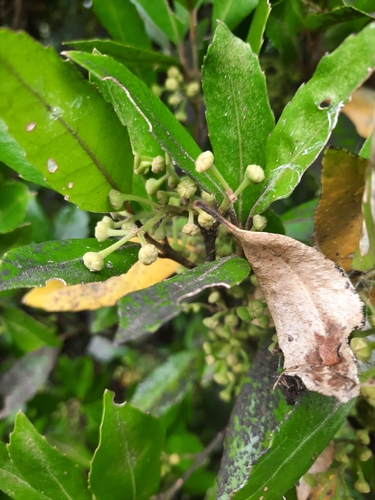
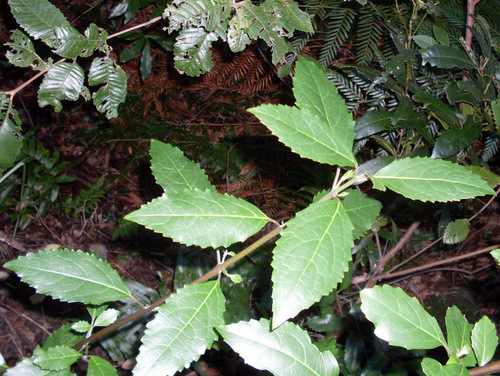
Hedycarya angustifolia A.Cunn. is a shrub or small tree that typically reaches a height of 2–10 meters (6 feet 7 inches to 32 feet 10 inches). Its leaves are elliptic, egg-shaped, or lance-shaped, measuring 40–160 mm (1.6–6.3 in) long and 15–60 mm (0.59–2.36 in) wide, and grow from a petiole 15–40 mm (0.59–1.57 in) long. The leaves have coarse teeth, and their midvein is prominent on both the upper and lower surfaces. This species is dioecious, meaning male and female flowers grow on separate individual plants. Male flowers grow in clusters of 5 to 16, with the entire cluster measuring 15–20 mm (0.59–0.79 in) long. Each male flower is roughly flattened cup-shaped, about 6 mm (0.24 in) in diameter, and sits on a pedicel 4–8 mm (0.16–0.31 in) long. Each male flower has 8 tepals and around 50 stamens. Female flowers grow in groups of 2 to 4. Each female flower is roughly cup-shaped, about 6 mm (0.24 in) in diameter, and sits on a pedicel 8–10 mm (0.31–0.39 in) long. Each female flower has 12 small tepals and 40–50 carpels. Flowering occurs from May to November. The fruit consists of tight clusters of spherical drupes that turn yellow or orange as they mature, with each drupe about 3.5 mm (0.14 in) in diameter. Hedycarya angustifolia grows in and near the edges of rainforest, often in moist mountain gullies. It is widespread from south-east Queensland, through eastern New South Wales and eastern and southern Victoria, to King Island in Tasmania. Indigenous Australians used the wood of this species for spear tips and to make bow drills.