About Hedlundia mougeotii (Soy.-Will. & Godr.) Sennikov & Kurtto
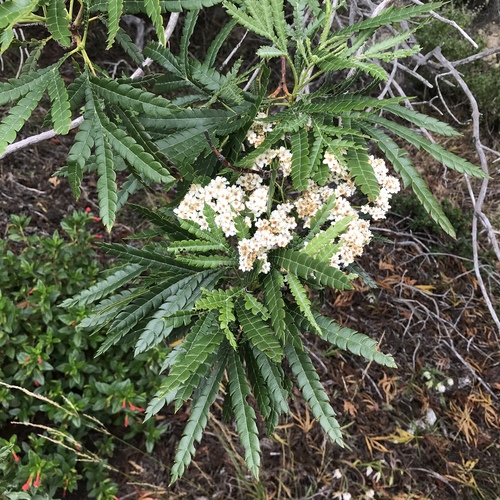
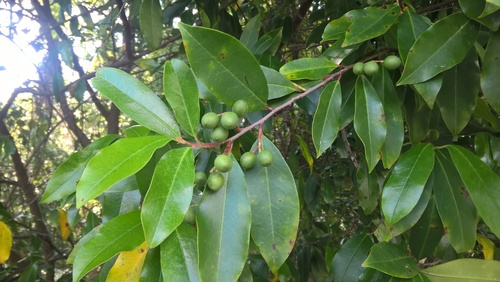
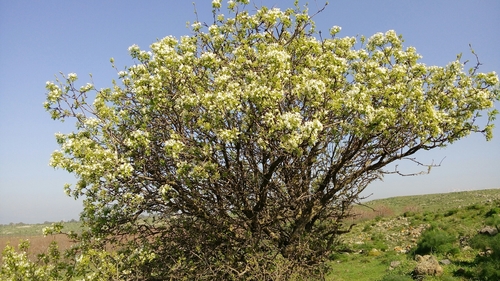
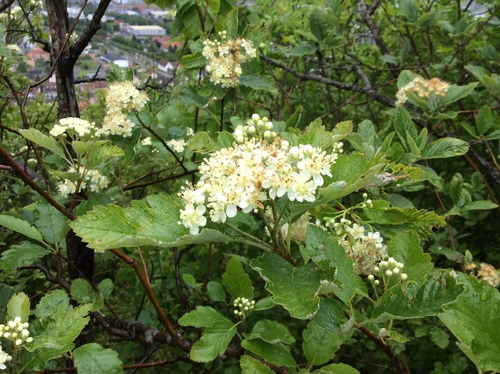
Hedlundia mougeotii, commonly known as the Vosges whitebeam or Mougeot's whitebeam, is a species of whitebeam native to the mountains of central and western Europe. Its native range extends from the Pyrenees east through the Alps to Austria, and north to the Vosges Mountains. It is a deciduous shrub or small tree that grows to 8–10 metres tall, rarely reaching 20 metres. It is often multi-stemmed, with trunks up to 30 centimetres in diameter, rarely 50 centimetres, and has grey bark. Its crown is dense, broad ovoid, and bears numerous erect branches. The leaves are glossy dark green on the upper surface, and covered in dense white hairs on the lower surface. They measure 6–10 cm long and 3–5 cm broad, with the widest portion near the middle of the leaf. The leaves are shallowly lobed, with seven to twelve forward-pointing lobes on each side, are bluntly pointed at the apex, and have serrated margins. Its autumn leaf colour is a dull grey-brown. The flowers are 10 mm in diameter, with five white petals and 20 yellowish-white stamens. Flowers are produced in corymbs 5–10 cm in diameter during late spring. The fruit is a globose pome 10–12 mm in diameter, bright red, that matures in mid autumn. The fruit has a somewhat dry texture, and is eaten by thrushes and waxwings, which disperse the plant's seeds. Hedlundia mougeotii's closest relatives are several endemic British whitebeams, most notably Hedlundia anglica, which differs only by having slightly broader leaves. It is also closely related to Scandosorbus intermedia, the Swedish whitebeam. Scandosorbus intermedia differs in having grey-white leaf undersides, more deeply lobed leaves with spreading rather than forward-pointing lobes, oval less bright red fruit, and grows as a stouter single-trunked tree with more horizontal branching. All of these species are tetraploid apomictic species that breed true without pollination, and all trace their origin to hybridization between Aria edulis and Sorbus aucuparia. Hedlundia mougeotii is widely grown as an ornamental tree in northern Europe, though it is usually unrecognised and misidentified as Scandosorbus intermedia. Although it was first described in 1858, it was only brought into widespread cultivation in the 1950s by the Danish Heath Society. At that time it was sold as a "new improved form of Sorbus intermedia", sometimes under the cultivar name 'Latifolia', which has additionally caused confusion with Karpatiosorbus latifolia. It is valued for its tolerance of urban conditions and poor difficult soil, and is very commonly planted in land reclamation schemes on slag heaps and in roadside shrub planting. It has also proven very tolerant of oceanic climates with cold summers, growing much better than S. intermedia in coastal conditions as far north as the Faroe Islands.