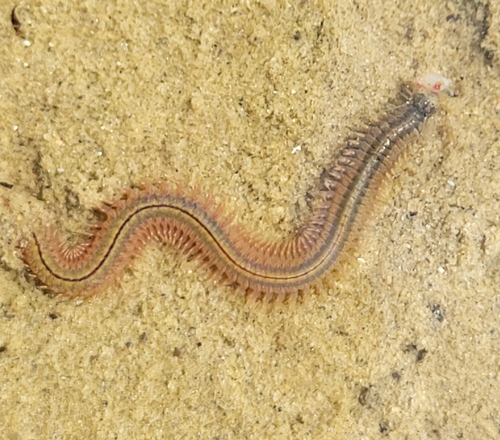
About Hediste diversicolor (O.F.Müller, 1776)
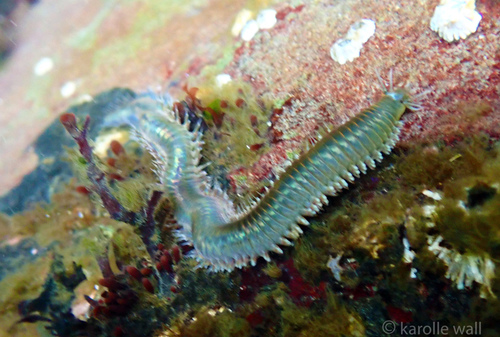
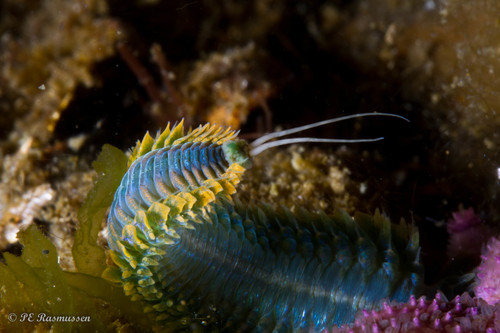
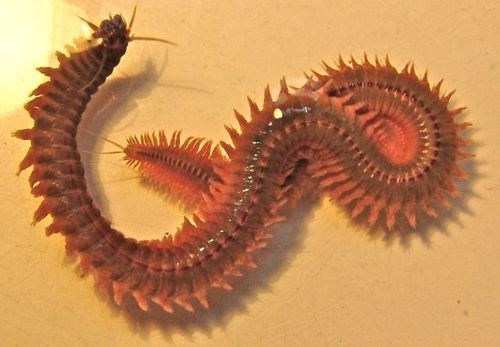
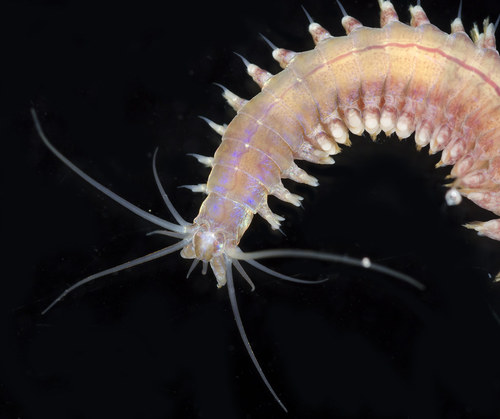
Hediste diversicolor, commonly known as the ragworm, can reach a maximum length of 10 cm (4 inches) when fully grown, and mature individuals typically have between 90 and 120 body segments. Its head bears one pair of palps, two pairs of antennae, four pairs of tentacles, and four eyes. Each body segment has a pair of bristly swimming appendages called parapodia. A distinct, prominent blood vessel runs along the dorsal (upper) surface of this species. This ragworm is naturally pale brown, but its color changes to green as gonads mature and the breeding season approaches. Hediste diversicolor is native to the north-east Atlantic Ocean, with a range that extends from the Baltic Sea and North Sea southward to the Azores and the Mediterranean Sea. It has been introduced to the north-west Atlantic, where it occurs in Cobscook Bay, the Gulf of Maine, and the Gulf of St Lawrence. It is abundant in intertidal zone habitats with sand, muddy sand, or mud, including areas with low salinity. In these habitats, it lives in a semi-permanent J-shaped or U-shaped burrow, and may also be found under adjacent stones. This species is widespread and common, and serves as prey for many bird and fish species. It is the main food source for the pied avocet (Recurvirostra avosetta), grey plover (Pluvialis squatarola), curlew sandpiper (Calidris ferruginea), bar-tailed godwit (Limosa lapponica), and curlew (Numenius arquata). Several species of intertidal mudflat-dwelling flatfish also feed on this ragworm, including the common dab (Limanda limanda), common sole (Solea solea), European flounder (Platichthys flesus), and European plaice (Pleuronectes platessa). Research has found that Hediste diversicolor has a harmful effect on the establishment of saltmarsh plant communities. In trials of Zostera noltei seagrass establishment in southern England, transplanting efforts were more successful when ragworms were excluded from the planting area. A similar adverse effect was observed in trials with Spartina anglica, a pioneering cordgrass used for coastal erosion prevention. Laboratory observations show that ragworms pull grass leaves into their burrows to feed on them. Researchers also believe that substrate disturbance from the ragworms' burrowing activities contributes to lower plant establishment rates. Hediste diversicolor is used as a model organism for laboratory research. It is also used to assess marine sediment quality, because it bioaccumulates certain heavy metals including lead, cadmium, chromium, and arsenic. Sea anglers use this species as fishing bait, digging it out of the substrate with a large fork, and it is also commercially available for this purpose.