About Hebeloma radicosum (Bull.) Ricken
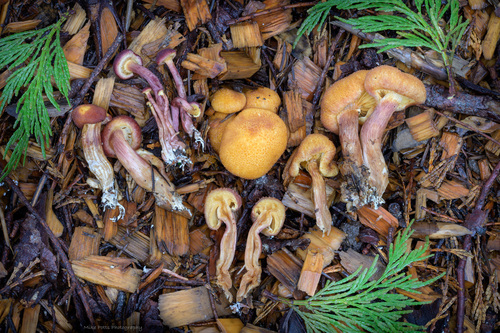
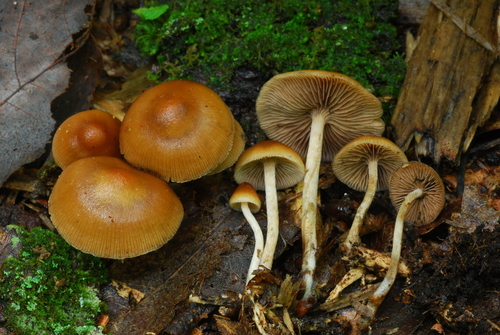
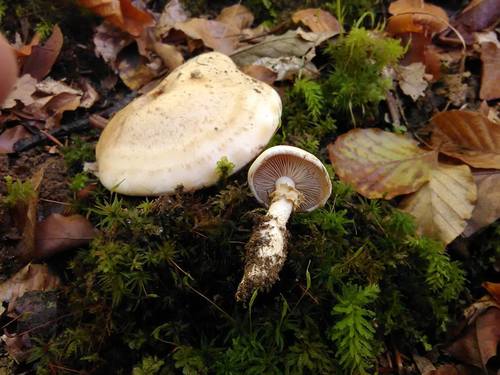
The fruit bodies of Hebeloma radicosum have caps 5–10 centimetres (2–4 inches) in diameter. Caps are initially convex and flatten out as they age. The surface of fresh caps is sticky; cap color ranges from yellowish tan to golden brown, ochre, or pale cinnamon, and is lighter towards the cap margin. Young cap margins curl inward, and often retain attached hanging remnants of the partial veil. The gills are notched to nearly free where they attach to the stipe, and have scalloped or fringed edges, especially when mature. Gills start out white, then change color from ochre to reddish brown as spores mature. The stipe measures 7.5–18 cm (3–7 in) long by 1.3–2.5 cm (1⁄2–1 in) thick, and is usually swollen in the middle and tapered at both ends. The stipe base has pale brownish fibers and cottony scales growing over a cream-colored base surface. The stipe is solid (not hollow) and firm, with a ring on its upper portion. The mushroom's flesh has a mild taste, and an odor of almonds or marzipan. Several aromatic compounds are responsible for this scent: benzaldehyde, 2-phenylethanal, 2-phenylethanol, phenylacetic acid, N-formylaniline, and 1-octen-3-ol. H. radicosum produces a rusty brown to cinnamon-brown spore print. Its spores are almond-shaped, covered in small warts, and measure 8–10 by 5–6 μm. The spore-bearing cells (basidia) are four-spored. This mushroom is poisonous, and causes gastrointestinal distress when consumed. This species is found in Japan, Europe, and North America. Fruit bodies grow on the ground, scattered or in groups, in soil or grassy areas, and are also associated with bushes and hedges in residential areas. H. radicosum is an ammonia fungus that associates with the latrines of moles, wood mice, and shrews. The mushroom has been used to study the nesting ecology of moles. A Japanese field study found that male flies of the genus Suillia rest on these mushrooms, actively defend their territory from other males of the same species, and wait to mate with egg-laying females. H. radicosum fruit bodies can be grown in pure laboratory culture. The fruit bodies are negatively gravitropic and not phototropic. While they do not need light to form primordia, light is required for primordia differentiation and fruit body maturation. This sensitivity to gravity and light may be linked to the fungus's growth habit: it colonizes deep underground where it forms primordia, then develops mature fruit bodies above ground on the surface.