About Hazardia berberidis (A.Gray) Greene
Hazardia berberidis (A.Gray) Greene is a loosely branched woody shrub that reaches 0.5–2 m (1.6–6.6 ft) in height. Its leaves are rigid, leathery, have sawtooth-like edges, and grow 1.5–5 cm (0.59–1.97 in) long. This species is similar to two other shrubby, toothed-leaf congeners: Hazardia rosarica and Hazardia squarrosa. It can be distinguished from these species by its ray flowers and erect, non-squarrose involucral bracts.
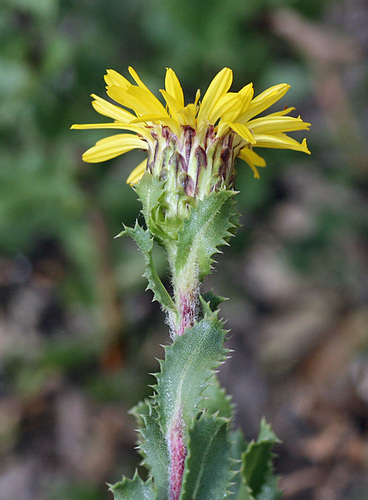
The branches of Hazardia berberidis measure 3–30 mm (0.12–1.18 in) in diameter and reach 5–10 dm (20–39 in) in length. They are covered with sparse villous hairs (trichomes), and remain leafy along their entire length. Internodes are typically around 1–2.5 cm (0.39–0.98 in) long, and usually bear small fascicles in the leaf axils. The leaves are sessile, ranging in shape from ovate-oblong to oblong. They measure 1.5–5 cm (0.59–1.97 in) long and 3–18 mm (0.12–0.71 in) wide. Most of the leaf surface is usually hairless, with any hairs that occur found on the prominent lower midrib near the leaf base. Leaf margins are distinctly dentate, with acute, spiny serrations along the entire edge.
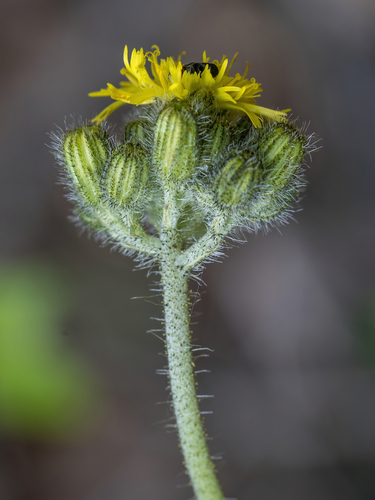
This species produces composite flower heads of the radiate type: yellow ray flowers surround a center of yellow disk flowers, and the flowers fade to dark red or purple as they age. Flower heads are borne either solitary at the ends of branches, sessile in a racemose capitulescence, or on leafy peduncles up to 3 cm (1.2 in) long. The involucres are shaped like a broad inverted cone or bell, and are shorter than the disk. They measure 1–2 cm (0.39–0.79 in) high by 1–1.5 cm (0.39–0.59 in) wide, and hold 30 to 60 erect bracts. 15 to 25 ray florets surround the central disk of florets. Ray florets have ligules 6–9 mm (0.24–0.35 in) long and 1.5–2 mm (0.059–0.079 in) wide, with a faint 3-lobed tip. The central flower head holds 30 to 60 disk florets. After flowering, both floret types produce achenes about 4–5 mm (0.16–0.20 in) long, each topped with a pappus of 30 to 50 brown bristles.
This species is endemic to Baja California, Mexico, where it occurs on the Islas Coronados, Islas Todos Santos, and the adjacent mainland coast extending south to El Rosario. It is primarily abundant in coastal habitats including beaches, bluffs, and sand dune edges, and also grows inland on hillsides and arroyos. It typically grows in the Mediterranean-type climate of coastal sage scrub and coastal succulent scrub, and is associated with Agave, Artemisia, Simmondsia, Opuntia, Rhus, and Atriplex species. While Hazardia berberidis also occurs in San Diego County, California, it is unknown if these populations are native or introduced.