About Haworthiopsis fasciata (Willd.) G.D.Rowley
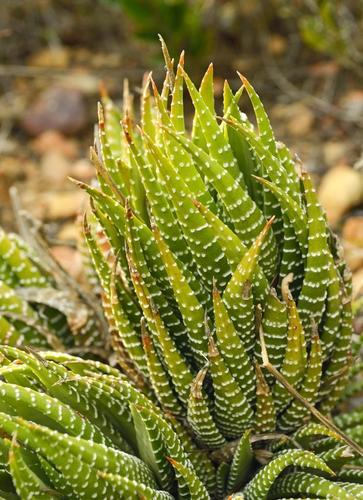
Haworthiopsis fasciata (Willd.) G.D.Rowley is generally a small succulent, growing less than 10 cm (4 in) high. It produces triangular green leaves marked with narrow white crested strips on the outer surface; each leaf ends in a blunt, non-acute spine. Its flowers bloom in October and November (summer in its native range), borne at the tip of an inflorescence. This species shares similar leaf markings with Haworthiopsis attenuata, a common houseplant, so the two are very frequently confused, and many H. attenuata specimens are mislabeled as the rarer H. fasciata. H. fasciata is rare in cultivation, and can be easily told apart by the smooth upper (inner) surface of its leaves: its white tubercles only grow on the lower (outer) leaf sides, while H. attenuata has roughness or tubercles on both sides of its leaves. The leaves of H. fasciata are also typically stouter, more distinctly triangular (deltoid), and curve inward more than those of H. attenuata. Unlike H. attenuata, older H. fasciata specimens sometimes develop long columnar stems. The most fundamental difference, which is not visible externally, is that H. fasciata has fibrous leaves; this trait differs from H. attenuata, but is shared with H. glauca, H. coarctata, H. reinwardtii, and H. longiana. In the wild, this species grows in acidic sands of fynbos vegetation, near Port Elizabeth and Uitenhage in the Eastern Cape, South Africa.