About Haworthiopsis attenuata (Haw.) G.D.Rowley
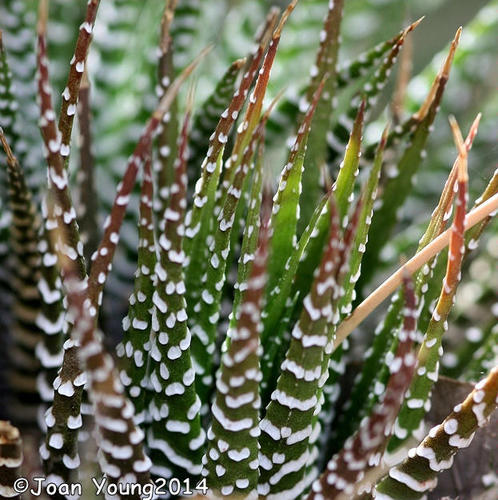
This is an evergreen succulent plant with short leaves arranged in rosettes 6 to 12 cm across. Its succulent leaves are tapered, which matches the meaning of the species epithet "attenuata", and bear bands of white tubercles. The species readily subdivides and produces offsets, growing into large clumps in the wild. Flowers appear in spring, which corresponds to November and December in the southern hemisphere. It is a popular houseplant thanks to its drought resistance and general hardiness. It is often confused with the much rarer similar species Haworthiopsis fasciata. H. attenuata can be easily distinguished by its white tubercles, which appear on both the upper and lower sides of its leaves; H. fasciata only has tubercles on the underside of its leaves, and has a smooth upper leaf surface. A key difference is that the leaves of H. attenuata are not fibrous. Additionally, the leaves of H. attenuata are often, though not always, longer, thinner, and more widely splayed out than those of H. fasciata. For cultivation, like most succulents, Haworthiopsis attenuata prefers soil with good drainage, such as commercial cactus mix, or fast-draining potting soil amended with sand. It grows well in bright light, but excessive direct sunlight can cause leaves to turn white or yellow. Water evenly and generously during summer, letting the soil dry out completely between waterings. In winter, it can be watered as infrequently as once every two weeks.