About Haworthia truncata Schönland
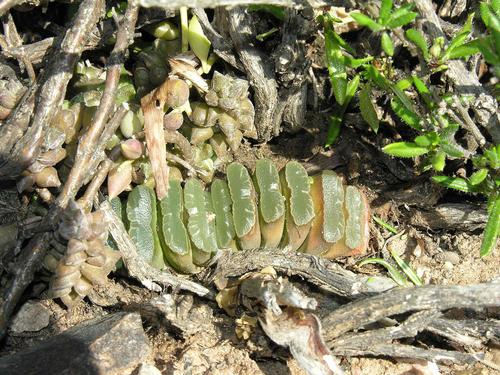
Haworthia truncata Schönland is a small succulent, reaching approximately 2 centimetres (0.79 inches) in height and 10 centimetres (3.9 inches) in width. This species is easily identified by its leaves, which have a nearly rectangular cross-section and are arranged in two opposite rows. The leaves are grey or grey-green, and grow more or less upright. The end of each leaf, its upper surface, looks as though it has been cut or truncated; this feature gives the species its specific epithet 'truncata'. The leaf surface is covered in white or grey lines and bears small warty verrucosities. In its natural wild habitat, plants are often half-buried in soil, with only the leaf tips visible above ground. The truncated leaf tip has a leaf window: it is translucent, which lets light enter the leaf to enable photosynthesis. This trait is shared with the species Lithops, Fenestraria, and Haworthia cymbiformis. The flowers of Haworthia truncata are not particularly showy; they grow as white, tubular clusters on a 20 centimetre (7.9 inch) tall stem. This species is increasingly common in cultivation and is very easy to propagate in large quantities. It can be propagated from seed, offsets, root cuttings, and even leaf cuttings. It also hybridizes easily with other Haworthia species. It requires very well-drained soil and some exposure to sunlight. It is also one of the few Haworthia species that can adapt to growing in a full sun environment. Its natural habitat is the arid Little Karoo, which receives sparse intermittent rainfall throughout the year. When grown in gentle, often semi-shade cultivation conditions, its leaves tend to grow upwards out of the soil. In temperate regions, Haworthia truncata is usually grown under glass or indoors, because it cannot survive freezing temperatures. When cultivated in the United Kingdom, it has received the Royal Horticultural Society's Award of Garden Merit.