About Hatiora gaertneri (Regel) Barthlott
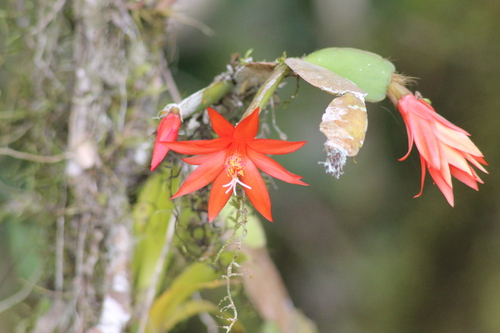
This species is currently accepted under the scientific name Hatiora gaertneri (Regel) Barthlott, and is also widely referenced by the synonym Rhipsalidopsis gaertneri in this description. It is native to southeastern Brazil, specifically found in the states of Paraná and Santa Catarina, growing at altitudes between 350 and 1,300 m (1,100 and 4,300 ft). It typically grows as an epiphyte on trees, and less commonly as a lithophyte on rocks, within subtropical rain forest. As it matures, it develops into a branching, pendant, leafless shrub with a woody base. Its stems are formed from individual segments; most segments are flattened, and function as the plant's photosynthetic organs called cladodes. Younger segments are dull green, measuring 4–7 cm (1.6–2.8 in) long and 2–2.5 cm (0.8–1.0 in) wide, with small notches along their margins. Areoles, the characteristic structures of cacti, develop inside these marginal notches. Flowers grow from areoles located at the tips of stems. The flowers are scarlet, 4–5 cm (1.6–2.0 in) long, radially symmetrical (actinomorphic), and open into a funnel shape with a maximum diameter of around 4–7.5 cm (1.6–3.0 in). After fertilization, plants produce red, oblong fruits. Under the common names Easter cactus or Whitsun cactus, this species is widely cultivated as an ornamental plant grown for its scarlet flowers. Its common names refer to its typical flowering period in the Northern Hemisphere, which occurs in late spring. It has been artificially crossed with the pink-flowered species Rhipsalidopsis rosea to produce the hybrid Rhipsalidopsis × graeseri; cultivars of this hybrid have flowers in a much wider range of colours. Easter cactus is generally considered more difficult to grow than Christmas or Thanksgiving cacti, which are cultivars and hybrids of the genus Schlumbergera. Recommended cultivation care is outlined as follows. For temperature, a summer temperature around 25 °C (77 °F) is suggested, and lower temperatures between 7–13 °C (45–55 °F) during winter (November to January in the Northern Hemisphere) to promote healthy bud formation. For light, as this species is naturally an epiphyte found in forest habitats, it does not tolerate exposure to strong direct sunlight. Half-shade conditions are recommended, and plants can be placed outdoors during the summer. For watering, Easter cactus responds poorly to both overwatering and underwatering, often reacting by dropping stem segments; continuously moist soil is recommended for growth. For propagation, stem segments can be cut in late spring, and their cut surfaces are left to dry out before being planted in slightly moist soil to root.