About Hasora taminatus (Hübner, 1818)
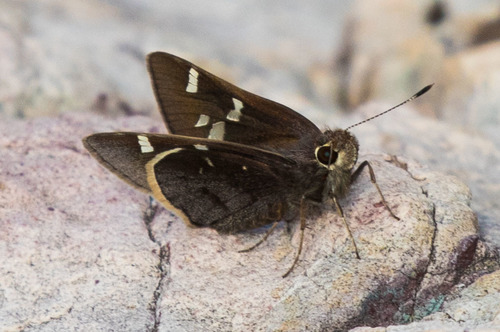
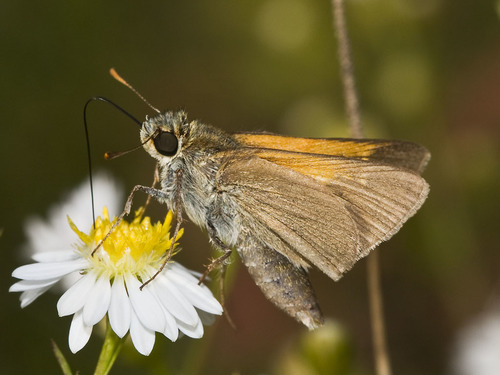
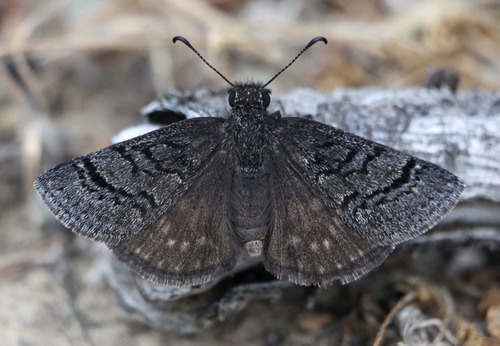
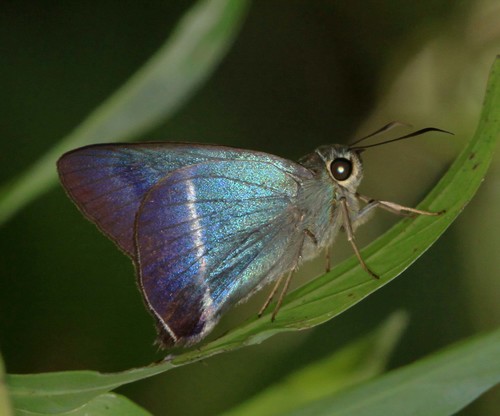
Hasora taminatus (Hübner, 1818), commonly called the white banded awl, is a butterfly species with a 40 to 55 mm wingspan. The upper side of its wings is dark brown and unmarked. It closely resembles the related species Hasora chromus (common banded awl), but differs by having a broad, sharply defined white band on the underside of its hindwing. Females of Hasora taminatus have small spots on the upper side of their forewing, while males have no scale brand on the upper side of their wings.
Edward Yerbury Watson published a detailed description of the subspecies H. t. malayana (C. & R. Felder, 1860) in 1891, which was originally recorded by Wood-Mason and de Niceville in 1881. The description notes that forewings are fuscous on the upper side; on the underside, the costal edge of the forewing and the basal half of the hindwing are steely blue-gray, and the hindwing has a white discal streak. For this taxon, Andaman females have a small semi-transparent yellowish discal speck located between the two posterior branches of the median vein, while Nicobar females lack this speck. All males of this species and its close relatives lack the oblique band of modified short scale lines that is present in males of other related species. H. t. malayana was originally recorded from the Andaman and Nicobar Islands. Due to overlapping ranges with the other subspecies H. t. bhavara Fruhstorfer, 1911 across part of its distribution, H. t. malayana has since been reclassified as a full separate species.
Hasora taminatus is distributed across Sri Lanka, India, Myanmar, Cambodia, Thailand, Laos, Hainan, Hong Kong, western China, Malaysia, the Indonesian archipelago (including Borneo, Sumatra, Java, Nias, Sumbawa and Bali), the Philippines, and Sulawesi. In India, it occurs in South India within the Western Ghats, Kodagu, the Nilgiri mountains, and the Palni hills. It is also found in the Himalayas from Mussoorie eastwards through Sikkim to Myanmar, as well as in the Andaman Islands and Nicobar Islands. The type locality of the species is South India.