About Harpegnathos venator (Smith, 1858)
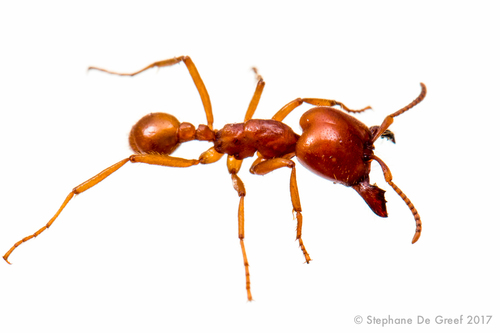
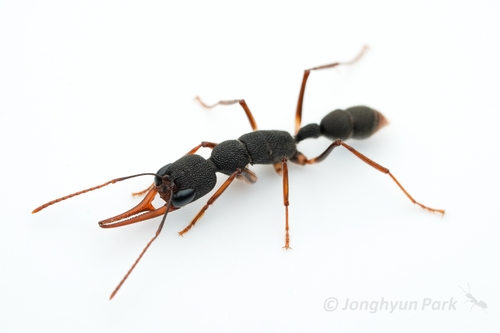
This taxonomic description of Harpegnathos venator (Smith, 1858) is sourced from C. T. Bingham's The Fauna of British India, Including Ceylon and Burma (Hymenoptera, Volume 2). For the worker caste: the body is black, while mandibles, clypeus, antennal carinae, and legs are brownish yellow; antennae are chestnut-colored, and the apex of the abdomen is rust-colored. The head and thorax are closely and coarsely cribrate punctate; the abdomen is finely and densely reticulate punctate, opaque, and marked with some large shallow punctures. The head, thorax, and abdomen are covered with rather sparse, short, erect pale hairs; the pubescence is minute but fairly plentiful, and only visible in certain lighting. All other characteristics match the traits of the Harpegnathos genus. For the queen caste: individuals are similar to workers, but the abdomen has long oblong punctures, and ocelli are positioned in the middle of the front. The thorax and abdomen are more massive, matching the form seen in Harpegnathos saltator. For the male caste: mandibles are broad at the base, becoming attenuate, narrow and slender toward the apex, which points forward. The head is rectangular, somewhat rounded, and broader than it is long. Eyes are rather smaller than those of the queen. There is a short depression between the mesonotum and scutellum, bordered by carinae and strongly striated on the interior. The body is generally smooth and shining, except for the thorax, which is coarsely rugose, punctate or striated, with longitudinal striation on the metanotum. The entire body is covered in fine yellowish pilosity, which is dense on the legs and less abundant in other areas. Pubescence is very sparse. The first abdominal segment is pyriform and appears to form a second node of the pedicel, with a slight constriction between the second and third abdominal segments. The thorax and pedicel are brownish black; the head and basal segment of the abdomen are reddish yellow. The rest of the abdomen is yellow with a red tinge. The legs and antennae are very pale testaceous. Harpegnathos venator mandibles are multifunctional. Their spatially-dependent morphology and bi-axial kinematics allow the ant to complete a range of daily tasks, from hunting and attacking to gently caring for ant eggs. Distal-to-middle sections of the mandible have double-rowed, non-parallel teeth that enable powerful clamping. The proximal section of the mandible has a smooth concavity, used exclusively for gently gripping ant eggs. The mandible rotates around two orthogonal axes, which simultaneously changes the distance and configuration between the two mandibles. This combination of spatially-dependent morphology and bi-axial kinematics gives the mandible its multifunctional capacity. Harpegnathos venator constructs nests with an entrance hole on sloped ground under forest shade. Nests hold between 8 and 70 individuals across multiple chambers. Workers and queens mostly remain in the upper chamber, with additional nest chambers located below. These disc-shaped chambers are connected by a single thin column or funnel, with a passage hole just large enough for one ant to pass through. Worker Harpegnathos venator are known to lay infertile trophic eggs that serve as food for reproductives.