About Harpegnathos saltator (Jerdon, 1851)
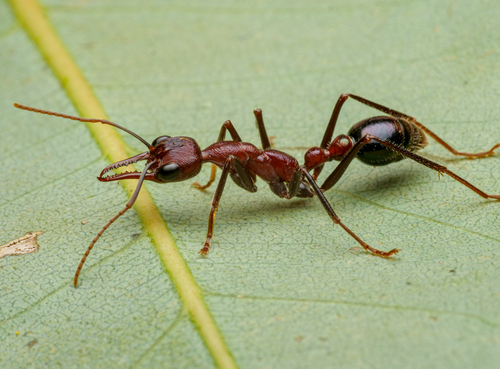
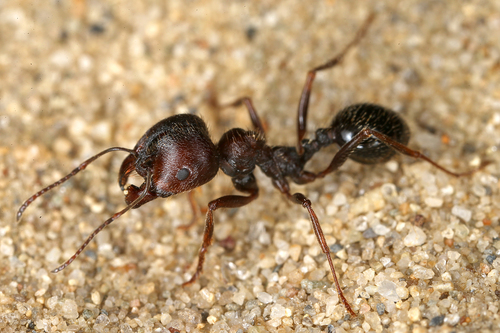
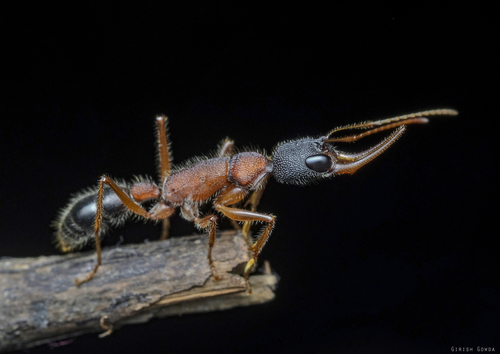
This is the original species description of Harpegnathos saltator (Jerdon, 1851), first published by T. C. Jerdon. For the worker caste, Jerdon describes: head is long and granulated; mandibles have a strong tooth near the base that points downwards and inwards, then taper gradually to the tip and are finely serrated, with mandibles measuring 1/6th of an inch long; the thorax is barely grooved; the abdominal pedicle is small, low and ovate; the abdomen is very long; the sting is large; the head and abdomen are blackish brown, while the thorax and legs are rufous, and total body length is 3/4 of an inch. Jerdon did not observe this distinct ant species in the Carnatic. He first encountered the species at Tellicherry, and later in other parts of Malabar. He also notes that the species is found in the Mysore region, based on information from Mr. Hamilton, a talented and industrious amateur entomologist. Jerdon chose the specific epithet saltator for the species because of its ability to make surprisingly large jumps when alarmed or disturbed. It is very pugnacious, and both bites and stings severely. It builds its nest underground, usually near the roots of a plant. Colonies of this species do not contain many individuals. It appears to feed on insects, which it often captures alive. Below is the taxonomic description from C. T. Bingham's Fauna of British India (Hymenoptera – Volume 2): Worker: Head, thorax and pedicel are ferruginous red, closely and rather coarsely punctured and granulated; abdomen is black and shining, not granulated, with finer and more scattered punctures; mandibles, antennae, and legs are yellow; the entire body is covered with short, sparse, erect pale hairs, and a minute, fine, sericeous shining pubescence on the mandibles, head, antennae, thorax, and legs that is only visible in certain lighting. Queen: Similar in appearance to the worker; the ocelli are positioned very low down, almost in the middle of the front of the head. Male: Mandibles are short, triangular, rather wide, and not elongated. The head is somewhat longer than broad, strongly constricted behind the eyes and extending to the occipital articulation. The concavity on the front of the head is shorter and broader than in D. venator. The posterior face of the metanotum is strongly margined. The first abdominal segment is pyriform and elongated, as in D. venator. There is no constriction between the two basal abdominal segments. A small median carina is located behind the occiput. The body is smooth and shining. The metanotum, pedicel and part of the sides of the mesonotum are coarsely rugose. The remaining portions of the thorax have some foveae or obsolete striae. Pilosity matches that of D. venator. Body coloration is reddish brown, with the pedicel darker. The abdomen is brown. Legs and antennae are pale testaceous. Wings are hyaline, with very pale nervures and stigma. This male description is based on work from Forel.