About Harpactes erythrocephalus (Gould, 1834)
The red-headed trogon (Harpactes erythrocephalus) has an average length of 34 cm (13 in). Among all trogons, the male’s red head and breast are a unique characteristic. The female resembles Diard's trogon, but does not have a speckled undertail.
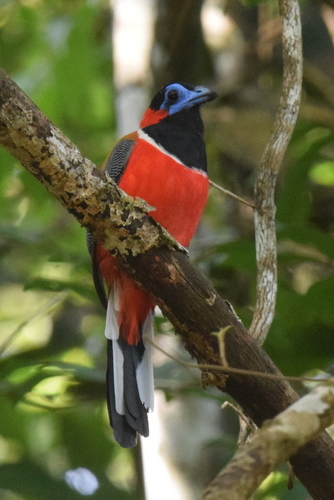
For an adult male: its head, neck, and upper breast are dull crimson. A narrow white band runs across the mid-breast, and the area from lower breast to abdomen below the band is light red to pink. The flanks are pale red, while the mantle and back are rusty brown. Males perch on branches with mauve-blue legs. For wing coloration: the lesser and median wing coverts, secondary coverts, and outer webs of the tertials and secondaries have black and white vermiculation, and the primary feathers are also black and white. Its long tail features dark brown central feathers with black tips, black second and third pairs of feathers, and outer pairs that are white with black bases. The male’s face has a black-tipped cobalt blue bill, a deep mauve-blue gape and eyering, and reddish-brown irises.
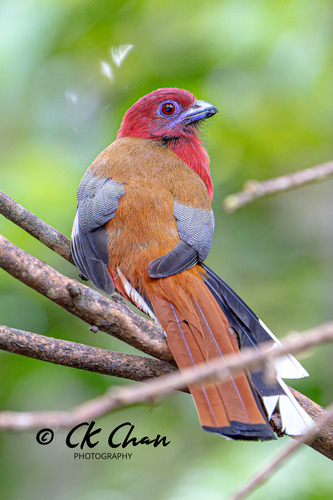
For an adult female: its head, neck, and upper breast are olive-brown. Like the male, it has a narrow white band crossing the mid-breast, with the area from lower breast to abdomen below the band being light red to pink. The mantle and back are orange to brown. Its wings have dark brown and yellowish brown vermiculation. The tail feathers are nearly identical to the male's. The female's bill, gape, and bare eyering are pale blue.
Juvenile red-headed trogons have buff brown heads, necks, and upper-parts, and buff white underparts. Their narrower central tail feathers lack the black tip that appears on adults.
The red-headed trogon is widely distributed, ranging from central Nepal, Southeast Asia, and southern China to Sumatra. It is uncommon to scarce in Nepal, where habitat destruction is the most likely cause of rapid population decline. It is fairly common in northeastern India, frequent in Bhutan, and locally dispersed in Bangladesh. It favors upland forests, and inhabits dense broadleaved forests in tropical and subtropical zones of the Himalayan foothills.
In Southeast Asia, it frequents broadleaved evergreen forests between 300 and 2,600 m (980 and 8,530 ft) in elevation. In Myanmar, it lives in bamboo and oak forests up to 2,500 m (8,200 ft) in elevation. In Laos, it occurs in evergreen forests and adjacent plains up to 1,700 m (5,600 ft). The forests of Vietnam are considered a stronghold for the species. In northern, western, and southern Thailand, it favors mature climax broadleaved evergreen forests between 400 and 2,000 m (1,300 and 6,600 ft). On the Malay Peninsula, it inhabits evergreen lowland, lower montane, and taller upper montane forests at elevations from 300 to 1,680 m (980 to 5,510 ft); farther south, it is rarely seen below 700 m (2,300 ft).
Red-headed trogons are often observed perching alone or in pairs on shaded branches, waiting to ambush prey. Their flight between trees is typically slow and low, only a few meters above the ground. They are most active in the early morning and at night, when they pursue moths along the edges of forest clearings. In central southern Thailand, it shares habitat with the Orange-breasted trogon (Harpactes oreskios); both species often follow foraging bird flocks to catch insects that the flocks flush out. It is sedentary across most of its range, but has been observed making elevational migrations in northern and southern Laos.
The red-headed trogon typically nests in a natural tree cavity 1.5 to 5 m (4 ft 11 in to 16 ft 5 in) above the ground. The entrance hole is generally wide; occasionally, a mated pair will excavate the entire cavity themselves, and they sometimes reuse old nesting holes created by woodpeckers or barbets. The female lays 2 to 4 round, cream-colored, glossy eggs that measure approximately 26.5 mm–27.5 mm × 23.5 mm–24.0 mm (1.04 in–1.08 in × 0.93 in–0.94 in). Both sexes participate in nesting processes, including excavation, incubation, brooding, and feeding offspring. Females handle more incubation and brooding, including all night-time incubation. Males provide food for the chicks. During the day, the pair broods in turns, and may also incubate together.
In Thailand, nesting takes place from March through July. Chicks hatch after an 18-day incubation period and leave the nest 13.4 days after hatching. In northern India, females lay eggs from mid-April to mid-July, with a peak in May and June. In China and Myanmar, egg laying occurs in April. On the Malay Peninsula, dependent juvenile red-headed trogons have been observed between early March and late May.