About Harpactes diardii (Temminck, 1832)
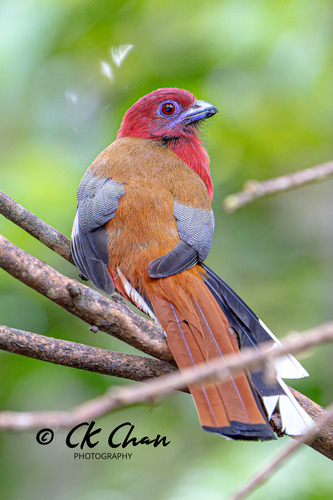
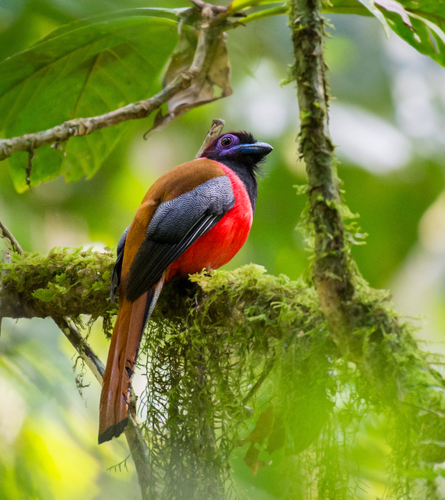
Diard's trogon (Harpactes diardii (Temminck, 1832)) is a medium-sized bird. It measures approximately 34 cm (13.4 in) in length and weighs about 100 g. Like other trogons, it has hunched shoulders, a long tail, and vibrant plumage with a striking mix of contrasting colors. Males and females are similar in size but have different plumage. Both sexes have a blue bill with a black tip. Adult males have a black head and upper breast, paired with a purplish-blue eye ring. A maroon wash covers the mid-crown to the hind-crown, while the hind collar and breastline are pink. The male's belly and vent are bright red, and its upperparts and uppertail are pale brown. Blackish markings on the male's undertail give it a grayish-white appearance. Adult females have plumage in more earthy, softer hues, with a muted brownish head and upper breast. Their lower underparts are a brighter pinkish-red than the male's. Juvenile Diard's trogons resemble females. This species is primarily found in the middle and lower layers of primary and logged forests in lowland and hilly regions. It occurs up to 900 m elevation in Peninsular Malaysia, and is rarely found above 600 m in Thailand. It also lives in peat swamp forests in Brunei and Sumatra, showing it can adapt to diverse habitats. In Borneo, it occupies a range of environments including lowland, upland, and highland dipterocarp forests, logged dipterocarp areas, streamside vegetation, and kerangas, a type of nutrient-poor heath forest. It can also be found in cocoa plantations near secondary forest areas, typically up to 1200 m elevation, though it is most often found at much lower altitudes. Its distribution covers the Thai peninsula, Peninsular Malaysia, the Indonesian and Malaysian parts of Borneo, and Bangka Island, which lies east of Sumatra in Indonesia. For reproduction, Diard's trogon excavates its nest in an old or dead tree trunk, usually at a height between 1 m and 3 m. The breeding season runs from February to mid-May in Peninsular Malaysia, and from mid-May to August (sometimes extending into September) in Borneo. Some individuals have been observed in breeding condition during February and April.