About Harpa amouretta Röding, 1798
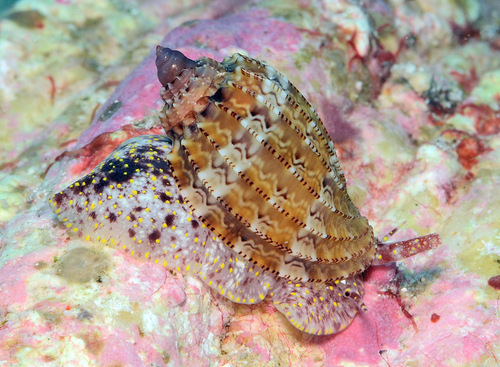
This species, Harpa amouretta Röding, 1798, shares a general shell description with Harpa harpa, growing up to 7 cm in size. Its shell is ovate, oblong, rather small, and slightly elongated, with 11 to 14 axial ribs, and a higher spire than related species. The whorls of the spire are distinct and mucronated, meaning they end in an abruptly tapering point. The body whorl has 11 to 12 narrow, slightly elevated longitudinal ribs; these ribs have a yellow base color crossed transversely by many very fine blackish lines that approach each other alternately in pairs. The intervals between the ribs bear very thin, delicate longitudinal striae, plus undulating bar-shaped brown and whitish lines. Sometimes one or two whitish bands are visible on the body whorl. The overall shell color is white, with cream and pale brown banding. The aperture is ovate and white, and the outer lip edge has several small brown bands; the outer lip is externally covered by the shell's last rib. The columella is almost straight, marked with small brown spots, and has a large, central purple blotch. This marine species is distributed across the Red Sea; the Indian Ocean from Northern Transkei, South Africa northward to East Africa including Somalia, Tanzania, Mozambique, and Kenya, as well as Madagascar, the Mascarene Basin, Aldabra, Chagos, Reunion, and Seychelles; the broader Indo-West Pacific; and waters off New Zealand and Australia, specifically the Northern Territory, Queensland, and Western Australia. There are not enough records to confirm that this species has a continuous distribution across northern Australia. It inhabits shallow and deep sands.