About Harmonia octomaculata (Fabricius, 1781)
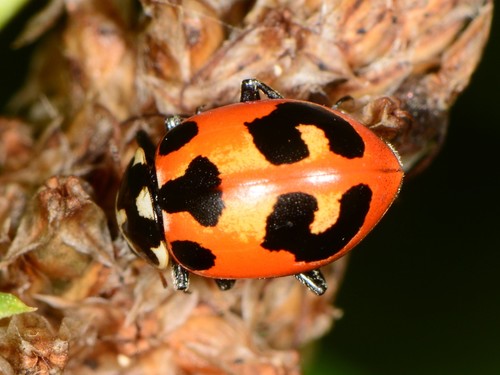
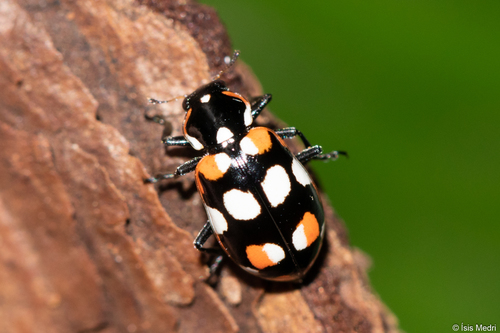
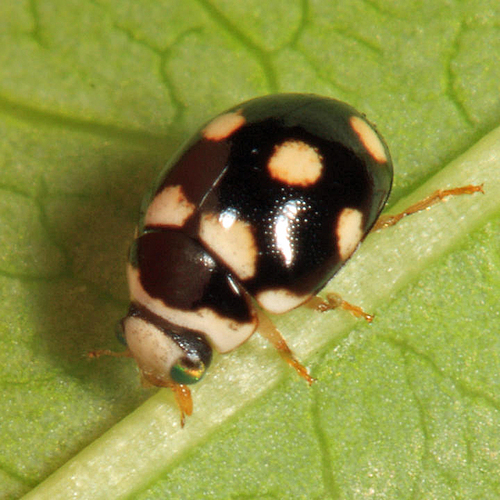
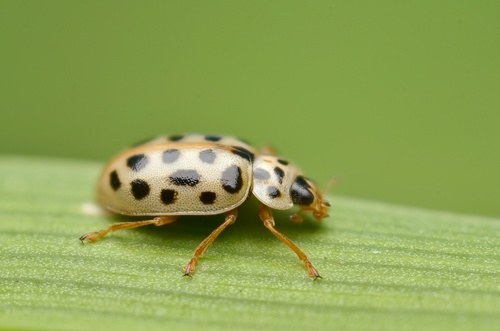
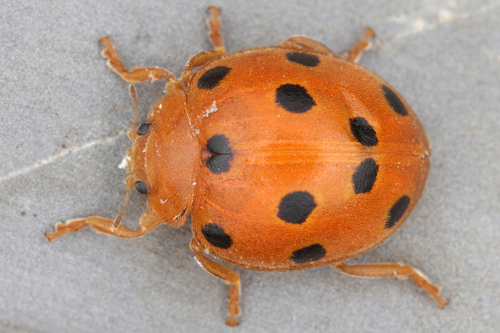
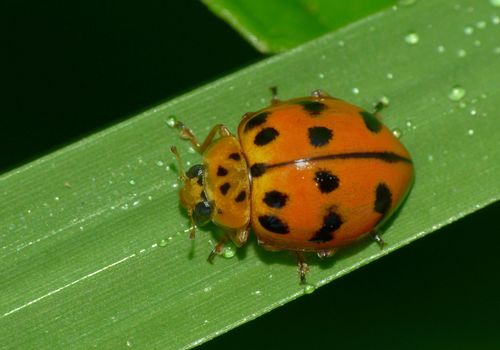
Harmonia octomaculata (Fabricius, 1781) is a rare species of ladybird that reaches approximately 8 mm in total body length. Its elytra are yellowish dark orange with black dots.
Adult females lay eggs either singly or in clusters of 21 to 52 eggs on both surfaces of leaves, and sometimes on the bodies of dead aphids. Eggs are yellowish and oval, measuring 1.25 to 1.37 mm in length. As eggs develop, they gradually turn black, becoming completely black just before hatching. The incubation period ranges from 3 to 4 days. After the apical portion of the egg splits, grubs begin to wriggle out. Neonate grubs remain on the empty egg case for some time before moving toward prey to feed.
The first instar larva is dark grey, entirely covered in spiny structures, and has a shiny dark head capsule. Its legs are darker in color, comparatively longer, and articulated with an oval-shaped body. First instar body length ranges from 1.75 to 2.08 mm, and the instar duration ranges from 1 to 2 days.
The second instar larva is shining black with a yellowish head capsule, later changing color to dark brown to black. Its entire body is covered with spiny structures, and its legs are black. Two orange spots are visible on the dorsolateral side of the first abdominal segment. The body is ventrally flat and slightly convex dorsally. Second instar body length ranges from 3.90 to 4.65 mm.
The third instar larva is very similar to the second instar, differing only in its larger overall body size and slightly larger spiny structures. A freshly moulted third instar is dark grey to black with orange spots, which become more prominent on the dorsolateral side of the first abdominal segment. Third instar body length ranges from 5.35 to 6.31 mm.
The fourth instar is deep black to dull black before the pre-pupal stage, with a series of orange spots on the first and fourth abdominal segments. Fourth instar body length ranges from 8.04 to 9.98 mm. The total larval development period ranges from 8 to 11 days.
When the fourth instar is fully grown, it stops feeding, becomes sluggish with a swollen body, and attaches its posterior abdominal segment to a leaf surface. Its body gradually changes into a characteristic 'C' shape before transforming into a pupa within a short period of time. The pre-pupal stage, which bears several orange spots on the body, lasts 1 to 2 days.
Pupae are initially yellowish and shiny, later turning pale orange yellow; fully developed pupae are yellowish orange with symmetrically placed black spots on each segment. Female pupae are comparatively larger than male pupae. The pupal stage lasts 3 to 5 days before the adult emerges. After emerging, the adult stays on the pupal case for a few hours until its body hardens, and during this time it is yellowish orange.
Newly emerged adults are soft and yellowish, with no markings. As they mature, adults become yellowish orange with black spots on the pronotum and elytra. Male beetles are small, oval, dorsally convex and ventrally flat, with a body length of 5.22 to 6.20 mm. Their pronotum is yellowish orange with an M-shaped black spot, though some males have no black spots. Their elytra are yellowish orange with two to four black spots, and sometimes lack black spots at each proximal end.
Females are similar to males in appearance, but are larger in size, with an average body length of 6.20 to 6.88 mm. The last abdominal segment of females is pointed to accommodate egg laying, while males have a rounded last abdominal segment. The total life cycle of males is 42 to 49 days, while that of females is 49 to 57 days.