About Harmonia conformis (Boisduval, 1835)
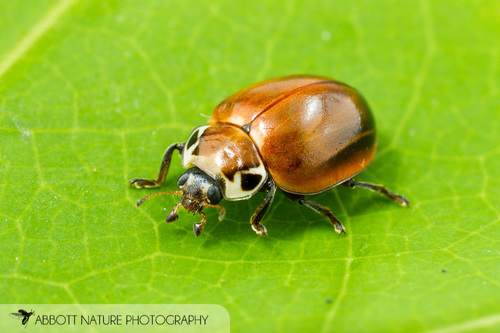
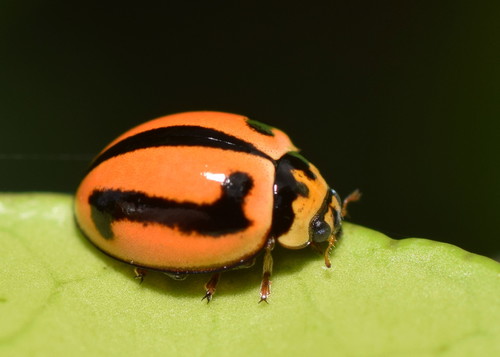
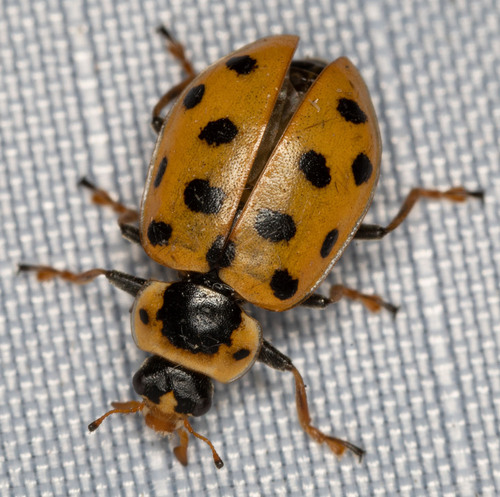
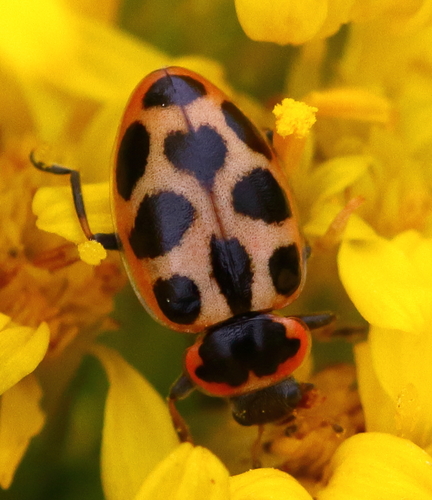
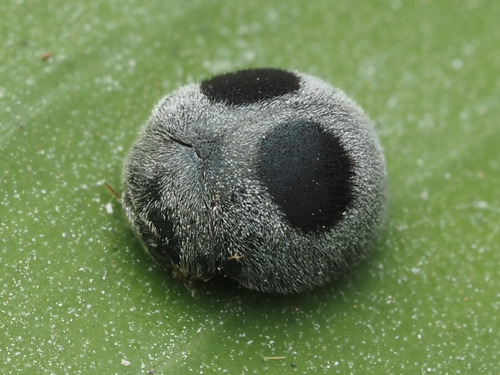
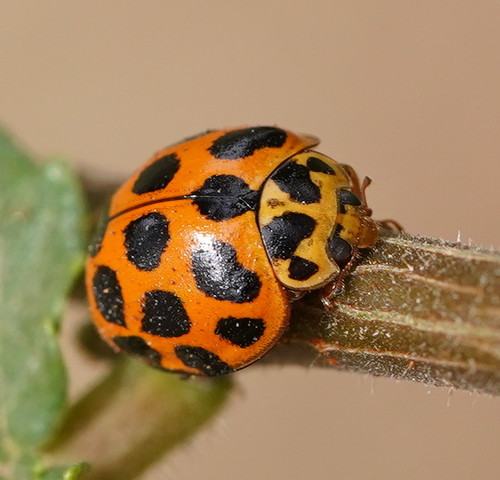
Harmonia conformis, commonly called the large spotted ladybird, is a species of ladybird in the family Coccinellidae. It has a light reddish body with 20 large black spots total, 18 of which sit on its elytra, or wing covers. It is relatively large for a ladybird, reaching approximately 6 to 7 millimetres in length. Both its larval and adult life stages are predatory, feeding on aphids. This species is native to Australia and has been introduced to New Zealand, where it is common across northern parts of the country. A smaller, native member of the same genus, Harmonia antipodum, also lives in New Zealand, and it is much harder to find than the introduced H. conformis. The life cycle of H. conformis is annual, and the length of each life stage depends on environmental temperature. Females lay yellow eggs in locations with ample prey available for newly hatched larvae. Larvae develop through four distinct instars. The first instar is dark grey with black legs and a black prothorax, and its scoli, which are fleshy extensions covered with setae, are black. The second instar has white-yellowish scoli instead. Third and fourth instars have variable colouration: the prothorax can be either black or yellow, the scoli on the first and fourth abdominal segments are usually yellow, and the scoli on the fifth through seventh abdominal segments may be black or yellow. When fully grown, the larva attaches itself to a plant to develop into a pupa. Adult ladybirds emerge from the pupa and then begin seeking mates.